
Every interaction with a large language model starts with a prompt. The words you type shape the response you receive, and small changes in phrasing can produce wildly different outputs. This is why practical LLM skills now include prompt engineering as a foundational concept.
Prompt engineering is the practice of structuring your inputs to get more accurate, useful responses from an LLM. It is not programming. It is closer to learning how to ask a clear question, give good context, and define what a useful answer looks like.
The concept matters because LLMs do not read your mind. They predict the most likely next words based on the text you provide. According to Anthropic’s prompt engineering documentation, structured prompts consistently outperform vague ones across all major models.
Key Takeaways
What Prompt Engineering Actually Means
The term “prompt engineering” sounds more technical than it is. At its core, it means writing clear, structured requests that help an LLM understand what you want.
Prompt engineering: The practice of designing and refining the text inputs given to a large language model to produce more accurate, relevant, and useful outputs. It involves choosing the right words, providing context, and specifying the desired format.
Think of it like giving directions. Saying “go left” is technically a direction, but “turn left at the third traffic light onto Oak Street” produces a far better outcome. Prompt engineering applies the same principle to LLMs.
Why It Exists
LLMs generate text by predicting the most probable next unit of text, called a token in a sequence. The prediction depends entirely on the input. A vague input creates a wide range of probable continuations, so the model picks from many possible directions.
A specific input narrows the range and focuses the output. This is not a flaw in the technology. It is how statistical language generation works.
The original transformer architecture described in the 2017 paper “Attention Is All You Need” built this prediction mechanism into the foundation of modern LLMs. Every model since, from GPT to Claude to Gemini, follows the same underlying principle.
Your input shapes the probability distribution. Your prompt is the steering wheel.
The Five Core Components
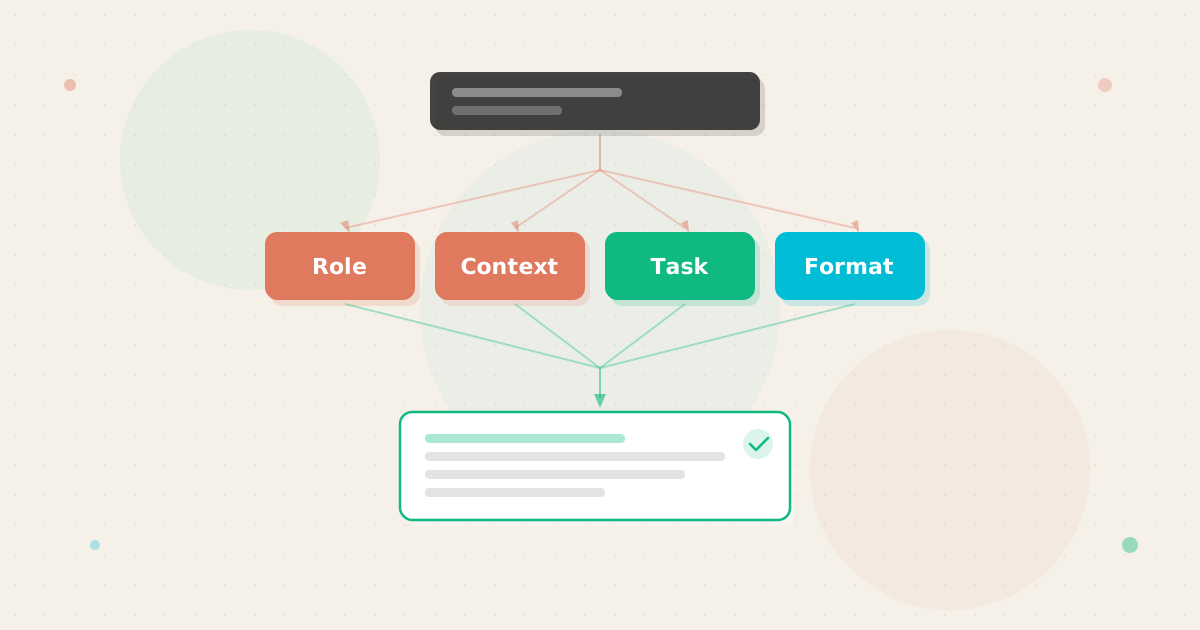
Every effective prompt contains some combination of five components. Not every prompt needs all five, but knowing them gives you a framework for improving any request.

Role assignment tells the model what perspective to adopt. Assigning a role like “experienced copywriter” or “data analyst” focuses the model’s language and reasoning toward a specific domain. The model does not become that expert, but it draws more heavily on training data associated with that role.
Providing context gives the model the background information it needs. This could include your audience, your industry, constraints you are working within, or relevant facts the model would not otherwise know. Models do not retain information between conversations, so context must be included every time you start a new chat.
The task component defines what you want the model to produce. This is the only truly required component. A clear task tells the model whether you want a summary, an analysis, a list, or a creative piece.
Without a defined task, the model guesses at your intent based on the other components.
Format instructions specify how the output should be structured. You might request bullet points, a table, a specific word count, or a particular tone.
Without format instructions, the model defaults to whatever structure seems most likely based on the input. Adding format instructions is one of the highest-impact changes you can make to any prompt.
Including examples shows the model what good output looks like. Including one or two examples of the desired result dramatically improves consistency. This connects directly to the concept of the few-shot approach, where examples serve as implicit instructions that the model follows.
How Prompt Engineering Shows Up in Practice
The difference between a basic prompt and an engineered one is visible in the output quality. Understanding how this concept works in real interactions helps explain why it matters.
System Prompts vs. User Prompts
Most major LLMs operate with two types of prompts. The system prompt sets the model’s overall behavior for an entire conversation. The user prompt is the individual message you send within that conversation.
When you open ChatGPT and select a custom GPT, that custom version runs on a system prompt written by its creator. The system prompt might say “You are a helpful cooking assistant who provides recipes in metric measurements.” Every response in that conversation follows those instructions.
User prompts are the messages you type during the conversation. They handle specific requests within the behavior the system prompt established. In Claude, for example, the API accepts detailed system instructions about tone, formatting, and domain focus that persist across every exchange.
For most people using LLMs through web interfaces, the user prompt is the primary tool. System prompts become relevant when building custom applications or using the API. However, understanding that system prompts exist helps explain why the same model can behave so differently in different applications.
Some platforms give users partial control over system-level behavior. ChatGPT’s Custom Instructions and Claude’s Project settings both allow you to set persistent preferences that shape every response without retyping them each time. This is system-level prompting made accessible to non-developers.
How Settings Influence the Response
Your prompt is not the only thing shaping output. The model’s temperature and sampling settings also play a significant role in what you see.
Temperature controls randomness. A low temperature like 0.2 makes the model pick the most probable next token almost every time, producing predictable, factual responses. A higher temperature like 0.8 increases variety and creativity but also increases the chance of inaccurate output.
Top-p (nucleus sampling) works alongside temperature by limiting the pool of tokens the model considers. Together, these settings define how much creative freedom the model takes with your prompt.
These settings interact with your prompt in important ways. A detailed, specific prompt with a low temperature produces highly focused results. A vague prompt with a high temperature produces scattered, unpredictable text.
The same prompt produces different outputs at different temperature values. Understanding both the prompt and the settings is important for getting consistent results.
Observing the Effect on Outputs
When prompt engineering works well, you notice it in three ways. The response directly addresses what you asked instead of wandering into irrelevant territory. The format matches your needs, and the tone aligns with your audience.
When it fails, the symptoms are equally clear. The model produces generic responses, misinterprets the request, or generates content that misses the point.
The pattern is consistent across every major model. A vague prompt like “write about marketing” gives the model almost nothing to work with. Adding a role, audience, format, and word count transforms the same request into something the model can execute with precision.
Most of these failures trace back to missing components in the prompt. The model is not broken. It simply filled gaps in your instructions with its best statistical guess.
This is related to why LLMs sometimes produce incorrect information. The model generates plausible text even when it lacks the information to generate accurate text.
Key Dimensions of Prompt Engineering
The major techniques in prompt engineering differ in complexity and purpose. This table maps the most common approaches and when each one applies.
| Technique | What It Does | Best For | Complexity |
|---|---|---|---|
| Zero-shot | Give the task with no examples | Simple, well-defined requests | Low |
| Few-shot | Include 1-3 examples of desired output | Consistent formatting, style matching | Low-Medium |
| Chain of thought | Ask the model to reason step by step | Math, logic, multi-step problems | Medium |
| Role assignment | Tell the model what expert to be | Domain-specific knowledge | Low |
| Format specification | Define the output structure | Reports, tables, structured data | Low |
| Constraint setting | Add rules the output must follow | Brand voice, compliance, accuracy | Medium |
| Iterative refinement | Build on previous outputs in conversation | Complex projects, drafts, editing | Medium |
These seven techniques cover the majority of prompt engineering in practice. Each builds on the five core components described above.
Zero-Shot Prompting
Zero-shot prompting means giving the model a task with no examples at all. It works well for straightforward requests where the model already knows what good output looks like. Asking “Summarize this paragraph in two sentences” is a zero-shot prompt.
The model’s training data contains enough examples of summaries that it produces a good one without additional guidance.
Few-Shot Prompting
Few-shot prompting adds examples to guide the model. According to OpenAI’s prompt engineering guide, even a single example can significantly improve output consistency. This approach excels when you need a specific format or style that the model might not default to.
The more unusual your desired format, the more helpful examples become.
Chain of Thought Prompting
Chain of thought prompting asks the model to show its reasoning before reaching a conclusion. Instead of jumping straight to an answer, the model works through the problem one step at a time. Research from Google on chain of thought reasoning demonstrated that this technique dramatically improves accuracy on math and logic tasks.
The key insight is that asking the model to explain its reasoning produces better final answers than asking for the answer alone. This works because the intermediate steps constrain the final output. Each correct reasoning step makes the next step more likely to also be correct.
Iterative Refinement
Iterative refinement treats the conversation as a collaboration rather than a single request. You send an initial prompt, review the output, and then ask the model to adjust specific parts.
You might ask an LLM to draft a project summary, review it, then request a stronger opening. Each round of feedback narrows the gap between what you wanted and what you received. This approach works especially well for writing and analysis tasks.
Constraint Setting
Constraint setting adds specific rules the model must follow. You might require a particular word count, forbid certain phrases, or insist on a specific tone.
Constraints act as guardrails that keep the output within boundaries you define. They work best when paired with a clear task component.
Strengths and Limitations
Prompt engineering gives you significant control over LLM output without needing any technical skills. Anyone who can write a clear sentence can write a better prompt.
Where It Works Well
The biggest strength is accessibility. Prompt engineering requires no coding, no special tools, and no paid software beyond access to the LLM itself. It works across every major model, from Gemini to Claude to ChatGPT.
It also scales well across tasks. The same principles that improve a simple email request also improve a complex analysis task. Good prompt structure transfers between models, so learning these techniques once pays off regardless of which LLM you use.
Another underappreciated strength is speed. Improving a prompt takes seconds. Compared to fine-tuning or building retrieval systems, prompt engineering offers the fastest feedback loop.
You change the prompt, see the result, and adjust again immediately.
Where It Falls Short
Prompt engineering cannot fix fundamental LLM limitations. No prompt makes a model reliably perform accurate math on large numbers. No prompt gives the model access to real-time information it was not trained on.
There is also a ceiling on complexity. For tasks that require consistent behavior across thousands of interactions, prompt engineering alone is not enough. These scenarios typically require fine-tuning, retrieval-augmented generation (RAG), or other technical approaches that go beyond what a single prompt can achieve.
Prompt engineering improves output quality but does not eliminate errors. Always verify factual claims, especially for numbers, dates, and technical specifications. The model can confidently produce incorrect information regardless of how well your prompt is written.
The model’s context window also constrains what is possible. Even models with large context windows lose track of details buried deep in long inputs. Gemini 2.5 Pro offers a 1 million token context window, but attention degradation still occurs.
Prompt engineering cannot overcome this limitation. However, placing the most important instructions at the beginning and end of your prompt helps the model retain them.
Common Misunderstandings About Prompt Engineering
Several popular beliefs about prompt engineering are either wrong or incomplete. Correcting them helps set realistic expectations.
“There Is One Perfect Prompt for Every Task”
There is no single ideal prompt. The best prompt depends on the model, the task complexity, the desired output, and even the temperature setting. A prompt that works perfectly in ChatGPT may need adjustment for Claude because each model processes instructions differently.
What does exist is a repeatable framework for building good prompts. The five components provide that framework. Writing better prompts is an iterative process, not a search for a magic formula.
“Longer Prompts Are Always Better”
Adding more words does not automatically improve results. A 500-word prompt filled with redundant context or contradictory instructions often produces worse output than a focused 50-word prompt.
The goal is completeness, not length. Include everything the model needs and remove everything it does not.
A well-structured short prompt beats a rambling long one. The model weighs all input equally, and irrelevant details dilute the signal from your actual instructions. Brevity with purpose is the target.
“Prompt Engineering Is Only for Developers”
This is the most common misconception. The concept originated in technical communities, and early discussions focused on API usage and code-level implementation. But prompt engineering applies equally to anyone typing a question into a chat interface.
If you have ever reworded a question because the first answer was not useful, you have practiced prompt engineering. The core skill, which is effectively communicating with LLMs, is a general literacy skill. It belongs to the same category as knowing how to write a good email or ask a clear question in a meeting.
“The Same Prompt Works Across All Models”
While the principles transfer between models, the exact wording often needs adjustment per model. Each model has different strengths, training data, and instruction-following tendencies. A role assignment that works well in one model might be interpreted differently by another.
Testing your prompt in the specific model you plan to use is always worth the effort. This does not mean starting from scratch each time. It means making small adjustments and checking whether the output still matches your expectations.
Start with the simplest possible prompt that describes your task. If the output is not what you need, add components one at a time: first a role, then more context, then format instructions. This approach helps you identify exactly which component was missing.
The techniques covered here form the conceptual foundation of prompt engineering. They apply whether you are writing content with LLMs, analyzing data, or brainstorming ideas.
Prompt engineering is not about memorizing tricks. It is about understanding what the model needs from you to produce its best work.
Conclusion
Prompt engineering is the skill of communicating clearly with large language models. Its five core components, role, context, task, format, and examples, give you a mental framework for improving any interaction with any model.
The concept is not about finding secret syntax or memorizing templates. It is about understanding that LLMs respond to the structure and specificity of your input.
Better inputs produce better outputs. That relationship holds true across every model and every use case.
Knowing how to choose the right LLM is one half of the equation. Knowing how to communicate with it effectively is the other. As models become more capable, prompt engineering becomes more valuable, not less, because the gap between a mediocre prompt and a great one only widens.
Frequently Asked Questions


