
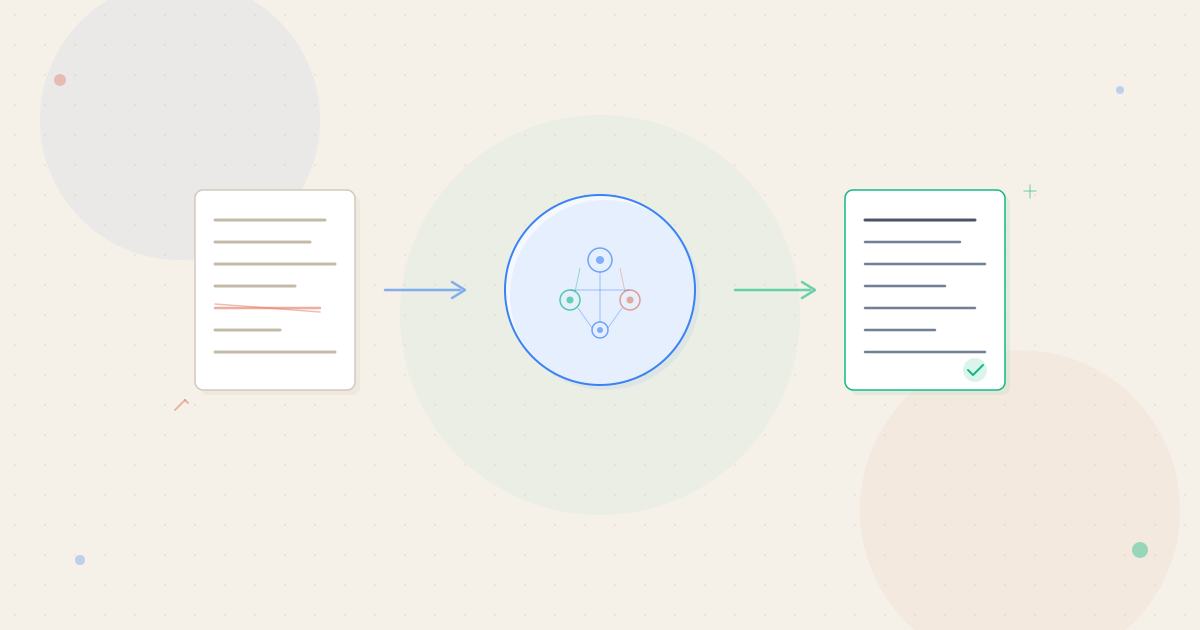
Every writer hits the blank page problem. You know what you want to say, but the words stall. Large language models can push past that wall, whether you need a rough draft, a tighter edit, or a new angle on a tired topic.
But LLMs are not magic ghostwriters. They produce faster than any human, yet the output needs shaping.
The real skill is knowing when to hand work to the model and when to keep it yourself. This is what makes AI writing tasks a skill worth building, not just a button to press.
The payoff is worth it. Writers who pair their own judgment with LLM speed report cutting first-draft time by 40-60% across blog posts, reports, and marketing copy. This guide covers the specific writing tasks LLMs handle well, which model to pick, and a step-by-step workflow you can start using today.
Most LLMs process text by breaking it into smaller units called tokens, which roughly translates to about 750 words per 1,000 tokens. Understanding this helps you estimate costs and plan the length of your writing projects when using paid models or APIs.
Key Applications
LLMs handle certain writing tasks better than others. Understanding where they add the most value keeps expectations realistic.
- Brainstorming and ideation: LLMs generate dozens of angles, headlines, or outlines in seconds. This is often their highest-value writing task because it replaces the slowest part of the process, staring at a blank page.
- First draft generation: Give a model a clear brief and it produces a workable rough draft. The output is rarely publish-ready, but it gives you raw material to shape. This works best for structured content like blog posts, product descriptions, and standard reports.
- Editing and rewriting: Paste in your existing text and ask the model to tighten sentences or fix grammar. You can also shift tone, like moving from formal to conversational. Models like Claude perform well at preserving your voice while cleaning up mechanics.
- Summarization: Long documents, meeting notes, or research papers can be condensed into clear summaries. This is a task where LLMs consistently outperform manual effort in speed without significant quality loss.
- Repurposing content: Turn a blog post into an email newsletter, a whitepaper into social media posts, or a transcript into a polished article. LLMs handle format shifts quickly because they understand structural conventions across content types.
- Research synthesis: Feed the model multiple sources and ask it to identify patterns, contradictions, or key themes. The model cannot verify facts on its own, but it can organize and compare information faster than manual reading.
- Copywriting variations: Need five subject lines for an A/B test, or three versions of a product description? LLMs produce variations without the creative fatigue that hits human writers on repetition-heavy tasks.
Not every writing task suits an LLM equally. Opinion pieces, personal essays, and humor require a human sensibility that models imitate but do not truly possess.
Which Model to Choose
Different models have different strengths for writing. Your choice depends on the task, your budget, and how much editing you want to do afterward.
| Writing Task | Best Model | Why | Cost (Subscription) |
|---|---|---|---|
| Long-form drafts (2,000+ words) | Claude Opus 4.6 | 1M token context, strong prose quality | $17/mo annual or $20/mo (Pro) |
| Blog posts and articles | GPT-5.2 / Claude Sonnet 4.6 | Good balance of quality and speed | $20/mo |
| Quick copy (emails, social) | GPT-5 nano / Gemini 2.5 Flash | Fast, cheap, good enough for short content | Free tiers available |
| Editing and proofreading | Claude Sonnet 4.6 | Preserves voice, precise rewrites | $17/mo annual or $20/mo (Pro) |
| SEO content | GPT-5.2 / Gemini 2.5 Pro | Strong at following keyword instructions | $20/mo |
| Creative writing | Claude Opus 4.6 | Most natural prose style at the frontier | $17/mo annual or $20/mo (Pro) |
A few things to note from this comparison. ChatGPT remains the most accessible option, with a free tier and the widest user base.
Claude tends to produce more natural-sounding long-form content, especially for tasks above 1,000 words. Gemini is strong for writers already using Google Workspace, since it integrates directly into Docs and Gmail.
For writers producing content at volume, API costs matter more than subscription fees. GPT-5 nano charges $0.05 per million input tokens, making it the cheapest option for bulk drafts.
Claude Haiku 4.5 offers a similar price-to-quality balance at $1.00 per million input tokens. The gap between free and paid LLM tiers matters because free models restrict access to the most capable versions. Choosing the best LLM for writing comes down to matching your output volume against these pricing tiers.
Step-by-Step Approach
A consistent workflow prevents the most common mistake with AI writing: prompting once, getting mediocre output, and giving up. The writers getting the best results treat LLMs as collaborative tools, not one-shot generators.
1. Define the writing task clearly. Before opening any model, answer three questions. What is the final format, who is the audience, and what is the one thing the reader should take away?
Vague requests produce vague output.
2. Write a detailed prompt. Include the format, word count, tone, audience, and any constraints. The more specific your instructions, the closer the first draft lands to what you need.
Strong results depend on learning to craft effective prompts, which separates useful output from generic filler.
Here is an example of a well-structured writing prompt:
3. Generate and evaluate the first draft. Read the output critically. Look for factual errors, generic phrasing, and sections that sound like filler.
Most first drafts need at least one round of revision. Do not publish a first draft from any LLM without human review.
4. Iterate with follow-up prompts. Ask the model to rework weak sections. “Make the introduction more specific” works better than “make it better.”
Direct the model to replace weak paragraphs with concrete examples. The model’s conversation memory keeps the full exchange available, so it can refine without losing track.
5. Edit with your own voice. This is the step most people skip, and it shows. Add your personal perspective and swap in better examples from your experience.
Cut any sentences that sound like they could appear in anyone’s article. Your edits are what make the piece yours.
6. Fact-check everything. LLMs confidently state things that are wrong. This reflects a well-documented tendency to fabricate information, and it happens in writing tasks more than people expect.
Verify any statistic, quote, date, or specific claim the model includes. Never trust an LLM citation without checking the source.
Here is a prompt for the editing stage:
Common Challenges
Every writer using LLMs runs into the same problems. Knowing them in advance helps you avoid the worst pitfalls.
LLM-generated writing often sounds confident but contains factual errors. Always verify statistics, quotes, and specific claims before publishing. The model does not know when it is wrong.
- Generic, bland output: The model defaults to safe, average prose. This happens most when prompts lack specifics. Fix it by adding constraints: a specific audience, a required example, or a word count ceiling that forces conciseness.
- Repetitive phrasing: LLMs reuse the same sentence structures and transition words, especially in longer pieces. Watch for patterns like every paragraph starting with “This” or “The.” Vary the output by asking for rewrites in a different style, or edit manually.
- Hallucinated facts and sources: The model invents statistics, misattributes quotes, and generates plausible-sounding citations that do not exist. This is the single highest risk of AI writing. Every factual claim needs independent verification.
- Loss of personal voice: Readers notice when writing sounds like it came from a template. The more you rely on raw LLM output, the more your content sounds like everyone else’s. Your edits, opinions, and examples are what differentiate it.
- Over-reliance on the tool: Some writers stop developing their own skills because the model handles the heavy lifting. Writing ability atrophies without practice. Use LLMs to speed up your process, not to replace your thinking.
- Inconsistent tone across sections: Long pieces sometimes shift tone between sections because the model treats each section somewhat independently. Reading the full piece aloud catches these shifts faster than scanning on screen.
Best Practices
These habits separate writers who get good results from those who get mediocre ones.
The best AI-assisted writing follows a simple ratio: spend 20% of your time prompting, 30% generating, and 50% editing. The editing phase is where quality happens.
- Start with an outline, not a full draft request. Ask the model to generate a structure first. Review and adjust the outline before requesting full sections. This prevents major rewrites and keeps the piece focused.
- Use role-based prompts for better tone. Telling the model “You are a technical editor for a developer blog” changes the output. Roles anchor the model’s style choices.
- Break long pieces into sections. Generating a 3,000-word article in one prompt often produces filler in the middle sections. Writing section by section, with specific instructions for each, produces tighter results.
- Keep a prompt library. Save prompts that produced good results. A collection of writing prompts tuned to your needs saves time and produces more consistent quality than writing new prompts from scratch each time.
- Set the model’s limitations upfront. Tell it what not to do: “Do not use marketing language. Do not include a generic introduction. Do not use filler phrases.” Constraints improve output more than aspirational instructions.
- Compare models for your specific task. A model that writes great blog posts may struggle with technical documentation. Test your actual writing tasks across ChatGPT, Claude, and Gemini before committing to one. The model-specific guides below explain each model’s strengths.
Here is a prompt that demonstrates the constraint-based approach:
When Not to Use LLMs for Writing
LLMs are not the right tool for every writing task. Knowing when LLMs help and when they hurt is just as important as knowing how to prompt them.
Personal essays and memoir-style writing depend on authentic lived experience. A model can mimic the format, but it cannot replicate genuine emotion or real memories. Readers recognize the difference, especially in personal storytelling where the author’s specific history is the point.
Legal documents, medical content, and financial advice carry real-world consequences if wrong. While LLMs can help draft structure, any writing with legal or safety implications requires expert human review, not just a quick edit pass. The model may produce text that sounds authoritative but misrepresents regulations or guidelines.
Opinion and analysis pieces lose credibility when the core argument comes from a model. Readers follow writers for their perspective. Outsourcing the thinking defeats the purpose.
Writing that requires deep subject-matter expertise, like academic research or specialized technical documentation, often exceeds what general-purpose models can produce accurately. The model fills gaps in its knowledge with plausible-sounding content that may be wrong.
High-stakes communications also deserve caution. Sensitive HR messages, crisis communications, and negotiations require human judgment about tone, timing, and political context that models cannot fully grasp.
If your goal is to develop your own writing skill, constant LLM assistance can slow that growth. Practice still matters for building voice, rhythm, and editorial judgment. Consider using LLMs for some tasks while writing others entirely by hand.
Model-Specific Guides
Each model handles writing differently. These guides cover prompting techniques, strengths, and limitations for specific models:
GPT-5.2 follows formatting and tone instructions well but tends toward formal language, which the ChatGPT writing guide addresses with specific workarounds for more natural output.
Anthropic’s Claude excels at long-form voice preservation, and the Claude for writing guide shows how to use its large context window for full-document editing passes.
Google’s Gemini integrates directly into Docs and Gmail for multimodal writing tasks, a workflow the Gemini writing guide covers alongside image-and-text content creation.
Conclusion
LLMs are at their most useful when you treat them as writing partners, not replacements. They eliminate blank-page paralysis, speed up first drafts, and handle repetitive copy tasks without creative fatigue.
The workflow that produces the best results is consistent: clear prompt, critical evaluation, human editing, fact-checking. Skip any of those steps and the output quality drops noticeably. The model you pick matters less than the process you follow, though choosing the right LLM for your specific writing needs does save time.
Start with one writing task you do regularly. Run it through a model using the step-by-step approach above.
Compare the time and quality against your usual process. That single test will tell you more than any guide can about where LLMs fit into your writing.
Frequently Asked Questions


