
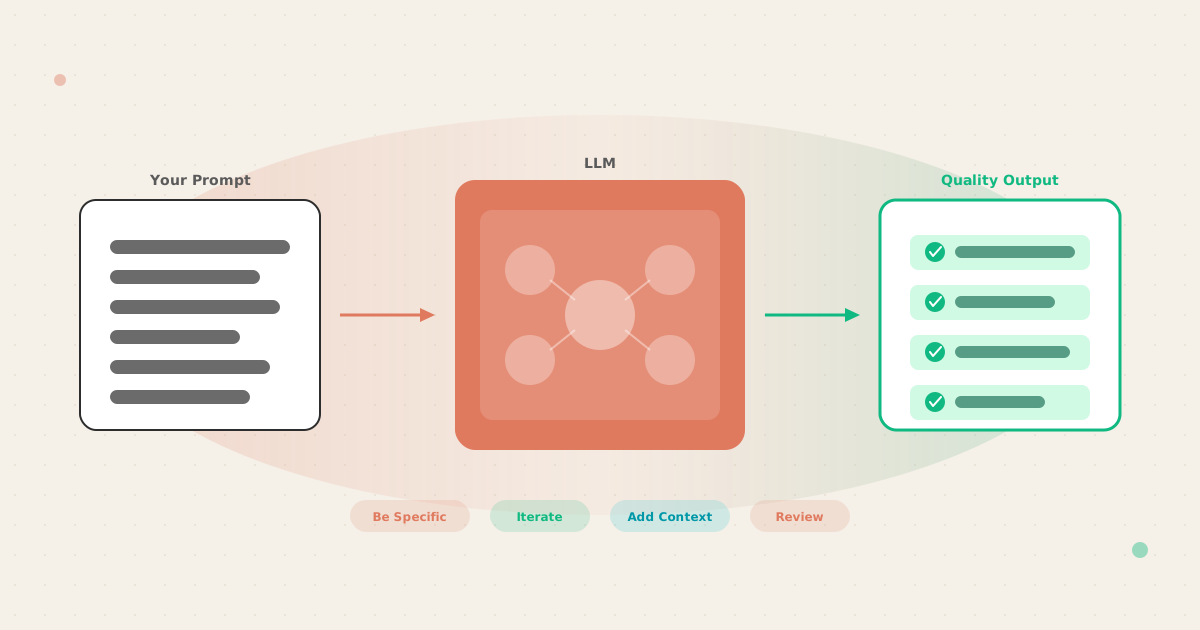
Most people start using large language models by typing a vague request and hoping for the best. The results are often mediocre, and that first experience shapes a lasting impression. It gives the false sense that these tools are either overhyped or too unreliable for real work.
The gap between disappointing results and genuinely useful output almost always comes down to how you interact with the model. Not what you pay for it, not which brand you choose. The practical side of working with LLMs involves a set of learnable skills, not technical expertise or special access. Understanding these skills changes LLMs from a novelty into a reliable part of how you work.
Effective use means knowing what to ask, how to ask it, and what to do with the response. It also means recognizing where these tools fall short. The difference between a frustrated user and a productive one is rarely about which model they chose. It is about the habits they built around using it.
Key Takeaways
What Effective LLM Use Actually Means
The word “effective” gets thrown around loosely when people talk about AI tools. For LLMs specifically, effective use means consistently getting outputs that are accurate, relevant, and useful without spending excessive time fixing or reworking them.
Effective LLM use: The practice of structuring your interactions with a large language model to produce reliable, task-appropriate outputs with minimal rework. It combines clear communication, appropriate model selection, and systematic output evaluation.
This is a different skill from traditional software use. With most software, you click buttons and get predictable results. LLMs are probabilistic. The same prompt can produce slightly different outputs each time. Small changes in how you phrase a request can dramatically change what you get back.
That unpredictability is not a flaw. It reflects how these models work. They predict the most likely next words based on your input. Give them vague input, and you get generic output. Give them specific, well-structured input, and the output improves significantly.

The Role of Input Quality
The single biggest factor in LLM output quality is your input. This includes the words you use, the context you provide, and the format you request. Researchers and practitioners consistently find that structured prompts produce higher quality results than casual, conversational requests.
Think of it like giving instructions to a new team member. Saying “write something about marketing” will get you a generic blog post. But a specific request changes things: “draft a 300-word email to existing customers announcing our 20% spring discount, friendly tone, one clear call-to-action.” That gets you something you can actually use.
This principle applies whether you are using ChatGPT, Claude, or Gemini. The specific interface differs, but the underlying dynamic is the same. Better input leads to better output.
Why Context Changes Everything
LLMs have no memory of your previous conversations by default. Each new session starts from zero. This means you need to provide relevant background every time you start a task.
Context includes who the output is for, what tone is appropriate, what format you need, and any constraints the model should follow. Providing context is not about writing longer prompts. It is about writing more targeted ones.
A prompt with 40 words of focused context will outperform 200 rambling ones. The goal is precision, not volume. The model needs to understand the boundaries and expectations of your request, and that understanding comes from how clearly you frame them.
Model Capabilities Are Not Unlimited
Every LLM has boundaries. These tools excel at language-related tasks: drafting, summarizing, translating, brainstorming, analyzing text, and generating structured content. They are not reliable for math calculations, real-time information, or tasks requiring access to private data they were not trained on.
Recognizing these boundaries early saves time and frustration. When you ask an LLM for something outside its strengths, the model will still produce an answer. It just will not be a reliable or accurate one. The model does not say “I am not reliable for this.” It generates confident-sounding text regardless, which is where LLM hallucinations become a real concern.
Effective users develop an instinct for when to trust an LLM response and when to verify it independently. Building that instinct is part of the learning curve.
How Effective LLM Use Shows Up in Practice
The difference between effective and ineffective LLM use is visible in everyday tasks. It shows up not just in the quality of outputs, but in the time spent getting there.
Matching the Model to the Task
Not every task requires the same model. A quick email summary does not need the same processing power as a detailed research analysis. Today’s LLM market offers models at every price and capability level, from free tiers to premium options costing $5.00 or more per million input tokens at the API level.
ChatGPT’s GPT-5 offers a 400,000-token context window for general-purpose work. Claude Opus 4.6 provides up to 1,000,000 tokens of context for handling long documents or complex reasoning. Gemini 2.5 Flash processes requests at $0.15 per million input tokens, making it practical for high-volume tasks where speed matters more than depth.
The effective approach is to match the model to the job. Simple tasks like reformatting text or generating quick summaries work well with smaller, faster models. Complex tasks like analyzing a 100-page report or maintaining context across a long conversation benefit from larger models with bigger processing capacity. Understanding context windows helps you make this choice.
Recognizing Output Patterns
Regular LLM users start to notice patterns in how models respond. Models tend to be verbose unless instructed otherwise. They default to a neutral, informational tone. They often include caveats and qualifiers that make text feel hedged.
Knowing these tendencies helps you counteract them in your prompts. If you know the model defaults to 500-word responses when you need 150, you include a word limit. If you know it tends toward formal language, you specify a conversational tone.
These patterns also appear in errors. Models are more likely to generate inaccurate information about recent events, niche topics, and specific statistics. Recognizing where errors cluster helps you know which parts of a response to verify first.
The Iteration Cycle
Effective use rarely means one prompt, one perfect result. Most real-world tasks involve iteration. You submit a prompt, review the output, refine your request, and try again.
This is not a failure of the tool. It is how these tools are designed to work. Research summarized in The Prompt Report: A Systematic Survey of Prompting Techniques highlights that effective prompting often involves iterative refinement rather than a single one-shot request. The first output gives you raw material. Your edits and follow-up prompts shape it into something finished.
Some users give up after one mediocre result and conclude LLMs are not useful. Others treat the first output as a starting point and refine from there. The second group consistently gets better results, often in less total time than doing the task manually.
Key Dimensions of Effective LLM Use
Several factors determine whether your LLM interactions produce useful results. Understanding these dimensions helps you diagnose problems when outputs fall short.
| Dimension | What It Means | Impact on Output |
|---|---|---|
| Prompt specificity | How clearly you define the task, constraints, and format | High: vague prompts produce generic responses |
| Context provided | Background information included in the request | High: missing context leads to irrelevant outputs |
| Model selection | Choosing the right model for the task complexity | Medium: over-powered models waste money, under-powered ones produce weaker results |
| Output format | Requesting a specific structure for the response | Medium: structured requests yield more organized, usable outputs |
| Iteration willingness | Refining requests based on initial outputs | High: single-pass attempts rarely produce polished results |
| Verification habit | Checking outputs for accuracy and relevance | Critical: unverified outputs risk factual errors and hallucinations |
The dimensions interact with each other. A highly specific prompt with good context sent to an appropriate model will produce strong results on the first attempt more often. But even with a perfect setup, verification remains non-negotiable.
The most impactful dimension for beginners is prompt specificity. Consider the difference between “help me with my resume” and something targeted. A request like “rewrite my experience section to emphasize project management, using bullet points” produces dramatically better output.
For users comfortable with basic prompting, the next biggest gains come from understanding how to evaluate and validate what models produce. This shifts your approach from passive acceptance to active collaboration with the model.
Strengths and Limitations of Current LLM Capabilities
Understanding where LLMs perform well and where they struggle is foundational to using them effectively. Misaligned expectations cause most of the frustration new users experience.
Where LLMs Excel
LLMs perform strongest on tasks that involve language comprehension and generation. Drafting emails, summarizing documents, translating between languages, brainstorming ideas, and restructuring existing text are all areas where models consistently deliver useful results.
They also work well for explaining concepts at different complexity levels, generating outlines and frameworks, and producing first drafts that a human can then refine. Writing tasks alone cover dozens of applications, from emails and reports to creative fiction and technical documentation.
Models are particularly good at tasks where “good enough” is the starting point, not the endpoint. A first draft that takes 30 seconds to generate and 10 minutes to edit often beats spending 45 minutes writing from scratch.
Where LLMs Fall Short
Factual accuracy remains an ongoing challenge. LLMs generate text based on patterns, not verified knowledge. They can state incorrect facts with the same confidence as correct ones. This is especially true for specific numbers, dates, and niche technical details where the training data may be sparse or outdated.
Complex mathematical reasoning, real-time data retrieval, and tasks requiring access to private systems are outside what standard LLMs can do reliably. Models also struggle with very long, multi-step logical chains where each step depends on getting the previous one right.
LLMs generate confident-sounding text even when the information is inaccurate. Always verify factual claims independently, especially specific numbers, dates, and niche details. The model will not flag its own uncertainty.
The documented limitations of large language models cover these boundaries in detail. Awareness of them is what separates productive use from frustrating trial-and-error.
The Human-AI Collaboration Model
The most productive framework for LLM use is collaboration, not delegation. You bring judgment, context, domain expertise, and the ability to evaluate quality. The model brings speed, breadth of knowledge, and the ability to produce text quickly.
When users try to delegate entire tasks without oversight, quality drops. When they treat the model as a collaborator that produces raw material for human refinement, results improve consistently. The ideal workflow looks like human direction paired with machine execution, followed by human review.
Common Misunderstandings About Using LLMs
Several widespread beliefs about LLMs lead people toward habits that produce worse results. Correcting these misunderstandings improves output quality immediately.
“The Most Expensive Model Is Always Best”
Model pricing reflects capability, but capability is not always what your task requires. A model with a 1,000,000-token context window processing simple email rewrites is like renting a moving truck to carry groceries. It works, but you are paying for capacity you do not need.
Choosing the right LLM based on task requirements saves money and often produces equivalent results. Smaller models are frequently faster too, which matters for tasks where response time affects your workflow.
“Long Prompts Get Better Results”
Prompt length and prompt quality are not the same thing. A 50-word prompt with clear structure and specific instructions outperforms a 500-word prompt filled with unnecessary background and contradictory requests.
What matters is the information density of your prompt. Every sentence should serve a purpose: defining the task, providing context, specifying format, or setting constraints. Understanding prompt engineering fundamentals helps you write prompts that are concise and effective.
“LLMs Understand What You Mean”
LLMs process text literally. They do not infer your intentions the way a human colleague might. If your prompt is ambiguous, the model will pick one interpretation and run with it. That interpretation may not match what you had in mind.
This is why specificity matters so much. “Make this better” could mean shorter, more formal, more persuasive, more detailed, or dozens of other things. The model guesses. Eliminating that guessing by stating exactly what improvement looks like is one of the fastest ways to get better results.
“One Good Prompt Handles Everything”
Different tasks require different approaches to structuring your prompts. A prompt that works well for creative brainstorming will not produce good results for data analysis. A prompt designed for summarization will fail at persuasive writing.
Effective users build a mental library of prompt patterns matched to task types. They learn through repeated practice which patterns work and when to adapt their approach. This kind of task-specific flexibility is what separates occasional users from people who get consistent value from these tools.
“If the First Output Is Bad, the Tool Does Not Work”
First outputs are starting points. Judging an LLM by its first response is like judging a writer by their first draft. The value comes from the iteration cycle: prompt, review, refine, repeat.
Models also perform better when you give them feedback. Telling the model what was wrong with its first attempt and what you want changed produces significantly better results on the second pass. This feedback loop is built into how these tools are designed to work.
Conclusion
Effective LLM use comes down to clear communication, realistic expectations, and a willingness to iterate. The technology is powerful and improving rapidly, but the results still depend on the person using it.
The most important shift is treating LLM outputs as collaborative drafts rather than finished products. When you combine your judgment with the model’s speed and range, the results are consistently better than either working alone. Building these habits takes practice, but the learning curve is shorter than most people expect.
Understanding when an LLM is the right tool for a task is the natural next step. Not every task benefits from AI assistance, and knowing the difference helps you invest your time where LLMs add real value. From there, exploring how leading models compare on real-world tasks turns general knowledge into practical, daily advantage.
Frequently Asked Questions


