
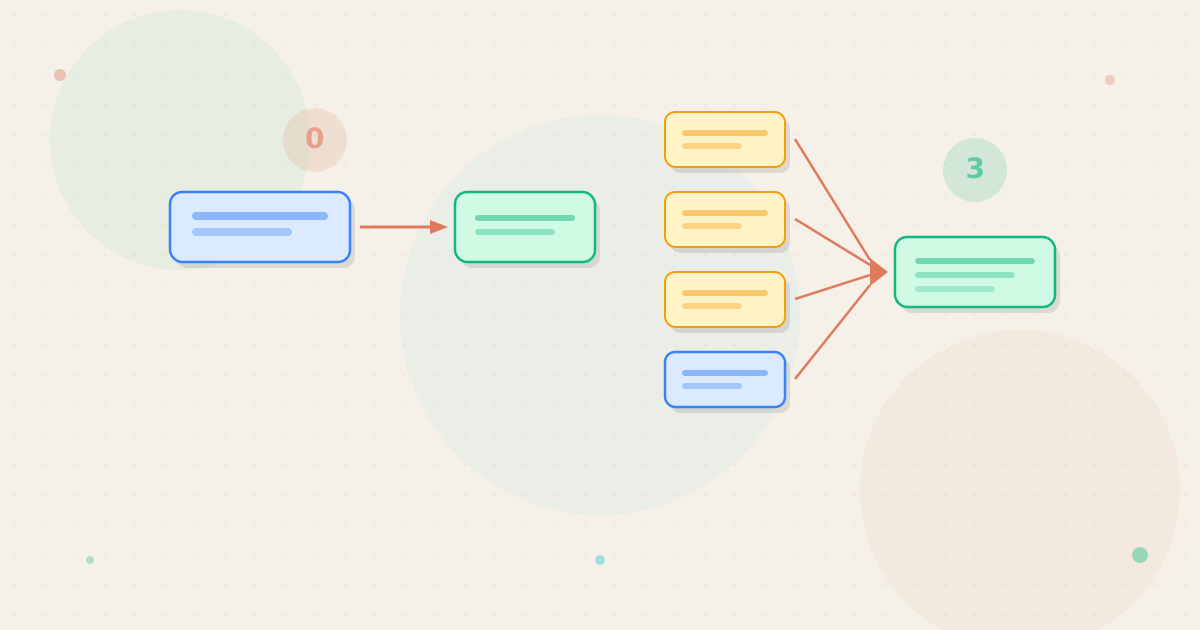
Every prompt you send to an LLM makes an implicit choice. You either let the model figure out what you want from your instructions alone, or you show it examples of what you expect. This distinction between zero-shot and few-shot prompting is one of the most practical concepts in working with LLMs effectively.
The difference sounds simple, but it shapes the quality, consistency, and format of every response you get. Knowing when to include examples (and when to skip them) can turn unpredictable outputs into reliable ones. It can also save you time and tokens when examples are not needed.
This concept applies across every major model, from ChatGPT to Claude to Gemini. Once you understand the trade-off, you can make better decisions about how to structure your prompts for any task.
Key Takeaways
What Zero-Shot and Few-Shot Prompting Mean
These two approaches represent different ways of communicating what you want from an LLM. The terms come from machine learning research. “Shots” refer to the number of examples provided to a model before it performs a task.
Zero-shot prompting: Giving an LLM a task with instructions but no examples. The model relies entirely on patterns learned during training to produce its response.
When you type “Summarize this article in three bullet points” into an LLM, that is zero-shot prompting. You described what you want, but you did not show the model what a good summary looks like. The model draws on its training data to interpret your request and produce an output.
Few-shot prompting: Including a small number of input-output examples in your prompt before asking the model to perform the same type of task. These examples teach the model your expected format, style, or logic.
Few-shot prompting works because LLMs are strong pattern matchers. When you show a model three examples of how you want product descriptions written, it picks up on the length, tone, vocabulary, and structure. It then applies those patterns to your actual request.
The term “few-shot” was popularized by OpenAI’s GPT-3 research in 2020. That research demonstrated that large language models could learn new tasks from just a handful of examples in the prompt. This was a major finding because it meant users could guide model behavior without any technical fine-tuning.
The original GPT-3 paper showed that in-prompt examples sometimes rivaled task-specific trained models. This finding is documented in Brown et al.’s research on language models as few-shot learners.

Where One-Shot Fits In
There is a middle ground. One-shot prompting provides exactly one example before the task. It works when a single demonstration communicates enough about your format and expectations.
For most practical purposes, the choice is between zero-shot and few-shot (two or more examples). One-shot serves as a lightweight alternative when a full set of examples feels unnecessary.
A Simple Way to Think About It
Zero-shot is like asking a new coworker to write a report by describing what you need. Few-shot is like handing them three finished reports and saying “write the next one like these.” Both approaches can work. The second one removes more guesswork.
How Zero-Shot and Few-Shot Prompting Affect Output
The practical impact shows up in three areas: output format, consistency across multiple runs, and accuracy on specialized tasks.
Format Control
Zero-shot prompts leave format decisions to the model. Ask an LLM to “classify this customer review as positive, negative, or neutral” and the format varies. You might get a single word, a full sentence, or a paragraph of explanation.
Few-shot prompts lock in formatting. Show the model three examples where each review gets a one-word label, and the fourth response will almost certainly follow that pattern. Format consistency is the most reliable benefit of few-shot prompting.
Consider a real example. You ask an LLM to extract the sentiment from a product review zero-shot. It responds with “This review expresses a generally positive sentiment toward the product, with minor complaints about shipping.”
That is useful, but unpredictable in structure. Run it again on a different review and you might get just “Negative” with no explanation.
Now add two examples showing the format you want: “Review: Love it. → Positive” and “Review: Broke after a week. → Negative.” The model mirrors that pattern. Every subsequent review gets a single-word label, ready for a spreadsheet or database.
Consistency Across Multiple Requests
If you need to process 50 product descriptions in the same style, zero-shot prompting will produce noticeable variation between outputs. The model generates each response independently, drawing on different patterns each time.
Few-shot prompting reduces this drift. The examples act as an anchor, keeping each output closer to your target. This matters most for batch tasks where uniformity is the goal.
Accuracy on Specialized Tasks
Modern LLMs handle most common tasks well without examples. Asking ChatGPT to translate a sentence or summarize a paragraph works fine zero-shot because these tasks are heavily represented in training data.
Specialized tasks are different. If you need the model to classify support tickets into your company’s custom categories, zero-shot performance drops. The model has never seen your specific labels.
Two or three examples of correctly classified tickets can improve accuracy by 10-30% depending on the task. These benchmarks come from Google’s PaLM research.
Legal document classification follows a similar pattern. Ask an LLM to sort contract clauses into categories like “indemnification,” “termination,” or “force majeure” zero-shot, and it will confuse overlapping categories. Two examples showing how your firm distinguishes between “limitation of liability” and “indemnification” give the model the context it needs.
The same principle applies to medical intake forms, insurance claims, and any domain with specialized labels the model has not seen during training.
Test your task zero-shot first. If the output format, tone, or accuracy does not meet your needs, add 2-3 examples before trying more complex prompt engineering techniques.
Key Dimensions of Zero-Shot vs Few-Shot Prompting
The table below compares these two approaches across the dimensions that matter most when choosing between them.
| Dimension | Zero-Shot | Few-Shot |
|---|---|---|
| Examples included | None | 2-5 typically |
| Token cost | Lower (shorter prompts) | Higher (examples consume tokens) |
| Format control | Model decides format | Examples define format |
| Output consistency | Varies between runs | More consistent |
| Setup time | Immediate | Requires preparing examples |
| Best for | Common, well-understood tasks | Custom formats, specialized tasks |
| Risk of copying | None | Model may over-mimic examples |
The token cost difference is worth noting. Each example you include consumes part of the model’s context window. A prompt with five detailed examples might use 500-1,000 tokens before you even reach the actual request.
For API users paying per token, this adds up across hundreds or thousands of calls.
The trade-off is straightforward. Few-shot prompting trades higher token costs for more predictable outputs. Zero-shot is cheaper and faster but leaves more to the model’s interpretation.
How Many Examples Is Enough
Research and practical testing suggest that 2-3 examples deliver most of the benefit for typical tasks. Going from zero to two examples produces the largest improvement in format adherence and accuracy. Adding a fourth or fifth example provides diminishing returns in most cases.
Some complex tasks benefit from more. Sentiment analysis with subtle edge cases (sarcasm, mixed sentiment) can improve with 5-6 examples. But beyond six, models rarely show measurable gains, and you start consuming significant context window space.
Example Quality Over Quantity
A few well-chosen examples outperform many mediocre ones. Anthropic’s research on prompt design confirms this pattern, as described in their prompt engineering documentation. Each example should represent a different scenario or edge case.
Repeating similar examples teaches the model less than diverse ones.
Bad examples actively hurt. If your examples contain inconsistencies in format or errors in labeling, the model will learn those patterns too. Every example teaches the model what you consider correct, so treat them like training data.
Avoid using examples that are too similar to each other. If all three examples involve the same type of input, the model may struggle with variations it has not seen. Include edge cases and different scenarios in your example set.
Strengths and Limitations
When Zero-Shot Works Well
Zero-shot prompting succeeds for tasks that LLMs encounter frequently during training. Translation, summarization, basic classification, grammar correction, and general Q&A all work reliably without examples. Models like GPT-5.2 and Claude Opus 4.6 have been trained on enormous datasets that give them strong baseline performance on common tasks.
It also works when you want creative or varied outputs. Writing brainstorming prompts, generating story ideas, or drafting email responses can benefit from letting the model draw freely on its training. Examples can constrain creativity when open-ended exploration is the goal.
When Few-Shot Is Necessary
Few-shot prompting becomes necessary when the model cannot guess your requirements from instructions alone. Custom taxonomies, brand-specific writing styles, and domain-specific labeling schemes all benefit from demonstration rather than description.
It is also the better choice for maintaining consistency across batch processing. If you need 100 social media posts that all follow the same structure, examples establish the pattern more reliably than written instructions describing that structure.
Structured data extraction is another strong use case. Suppose you need to pull names, dates, and dollar amounts from invoices and return them as JSON. A zero-shot instruction describing the desired fields often produces inconsistent key names or nesting.
Two examples showing the exact JSON structure you expect will anchor the output format across dozens of documents. This is why few-shot prompting is popular in data pipelines where downstream systems depend on a predictable schema.
Limitations of Both Approaches
Zero-shot performance drops on rare or highly specialized tasks. If the model has limited training data for your specific domain, instructions alone may not bridge the gap. Reducing errors in specialized domains often requires examples.
Few-shot has its own pitfalls. Models can over-fit to your examples, copying specific phrases or structures too literally rather than extracting the underlying pattern. They also consume tokens, which matters for long documents or API-heavy workflows where managing costs is a concern.
Common Misunderstandings
“Few-Shot Is Always Better”
This is the most widespread misconception. Many users default to including examples on every prompt, even when zero-shot would produce identical results. For standard tasks on modern models, examples add cost without improving output.
Start with zero-shot. Add examples only when the results fall short.
“More Examples Means Better Results”
Packing a prompt with 10-15 examples rarely helps and often hurts. Beyond 3-5 examples, models may fixate on superficial patterns in the examples rather than extracting the underlying logic. Excessive examples also eat into the available context length, leaving less room for the actual input.
“Zero-Shot Means No Instructions”
Zero-shot means no examples, not no instructions. You can (and should) still write clear, detailed instructions in a zero-shot prompt. Specifying tone, length, format, and audience all improve zero-shot performance.
The “zero” refers only to the absence of worked examples.
Many users confuse minimal effort prompting with zero-shot technique. A one-line prompt with no instructions and no examples is not a strategic zero-shot approach. It is just a vague prompt. Good prompt engineering applies to both approaches, and detailed instructions matter even when you skip examples.
“Few-Shot Only Works for Classification”
While classification tasks are the most commonly cited example, few-shot prompting works for creative writing, code generation, data transformation, and many other tasks. Any situation where “show, don’t tell” communicates your requirements more clearly than written instructions is a candidate for few-shot.
Conclusion
Zero-shot and few-shot prompting represent a practical choice you make every time you write a prompt. Zero-shot works for familiar tasks where the model’s training is sufficient. Few-shot gives you control when format, style, or domain-specific accuracy matters.
The best approach is to start simple. Try zero-shot first, then add examples only when the output needs correction. This keeps your prompts lean and your costs down while giving you a clear path to improvement when needed.
Understanding this distinction is a foundation for more advanced techniques. Concepts like chain-of-thought reasoning and adjusting model settings build on the same principle of giving the model the right amount of guidance. For a broader view of how these approaches fit together, the patterns also apply when comparing model capabilities across different providers.
Frequently Asked Questions


