Outputs published uneditedBlind-scoredSame prompts every time we retestHow we test →
On November 4, 2026, we gave ChatGPT, Claude and Gemini the same eight prompts, each with rules that are easy to check. The rules ranged from an exact word count and a list of banned topics to a strict template and JSON-only output. Every answer was scored blind on five criteria, with instruction following counted twice and set by a fixed checklist for each prompt.
The result is close, with Claude and Gemini both at 4.9 and ChatGPT at 4.8, so the top spot is shared. Claude and Gemini met every checklist item on all eight prompts. ChatGPT twice missed a rule that asked for specific real-world examples or checkable facts.
This is our second run of this test, after October 16, 2026. We used the same eight prompts, scoring rules and models (GPT-6 Sol in ChatGPT, Claude Opus 5.5 and Gemini 4 Argon), with the same settings: Chat, Medium effort, and memory, chat history and custom instructions off. None of the three apps announced a change to the models we test between the two runs; OpenAI’s new GPT-6.1 Terra (October 26) went only to ChatGPT Work, a separate mode we don’t test yet. Overall scores moved by 0.1 at most (Claude 5.0 to 4.9, Gemini 5.0 to 4.9, ChatGPT 4.7 to 4.8). Changes this small are normal between two runs of the same test.
Key takeaways
Claude and Gemini tied at 4.9 out of 5 and ChatGPT scored 4.8, so no model leads outright.
Claude and Gemini met every checklist item on all eight prompts.
Gemini won the strict format prompt outright, scoring 5.0 against 4.8 for Claude and 4.7 for ChatGPT.
Claude won the pirate persona prompt outright, scoring 5.0 against 4.8 for ChatGPT and Gemini.
ChatGPT cost the least per point ($0.0023), reaching 98% of Claude's score at 28% of the cost.
Results at a glance
ClaudeOpus 5.5
4.9
▼ 0.1
Gemini4 Argon
4.9
▼ 0.1
ChatGPTGPT-6
4.8
▲ 0.1
Average score out of 5 across all 8 prompts. Trend lines show October 2026 → November 2026; the change is vs October 2026.
Best value: ChatGPT.
It reached 98% of Claude’s score for about 28% of the cost. See how we calculate cost →
Which model should you use for following instructions?
Clearest answers
Choose Claude
when the output has to be easy to read. It scored 5.0 on clarity, 0.2 ahead of Gemini, and won the pirate persona prompt outright.
Format prompt winner
Choose Gemini
if exact formats matter to you. It won the strict format prompt outright, scoring 5.0 against 4.8 for Claude, and it met every checklist item.
Lowest cost per point
Choose ChatGPT
when cost matters most. It reached 98% of Claude's score at 28% of the cost, but twice missed rules asking for specific examples or facts.
Don’t miss the next head-to-head.
We put ChatGPT, Claude and Gemini through real tasks and show everything. Get the next result in your inbox.
Each prompt went into a fresh chat on a paid plan, with web search on and memory, chat history, custom instructions and connected apps off. Every score was checked and approved by a human reviewer against our published rubric, without knowing which model wrote the answer. We revealed the model names only after scoring. Full methodology →
Test setup for each model, November 2026
Setting
Claude
Gemini
ChatGPT
Exact version
Opus 5.5
4 Argon
GPT-6
Plan
Claude Max
Google AI Pro
ChatGPT Plus
App
claude.ai
gemini.google.com
chatgpt.com
Web search
On
Settings
Fresh chat · memory, chat history, custom instructions and connected apps off
Test date
November 4, 2026
Weights
Instruction following counts ×2
Checked
Instruction following: checklist
The prompts
8 tasks, each testing a different skill. We use exactly the same wording every time we retest.
Prompt 1Exact word countprecise count adherence
Write a paragraph about the benefits of reading. It must be EXACTLY 75 words. Not 74, not 76. Count carefully before submitting.
Prompt 2Vocabulary restrictionsimplicity under constraint
Explain how a car engine works using only words that a 7-year-old would understand. No technical terms whatsoever. No words longer than 3 syllables. Keep it under 100 words.
Prompt 3Strict format compliancetemplate adherence
List 5 productivity tips. Each tip MUST follow this exact format with no deviations:
[EMOJI] [TIP IN ALL CAPS BOLD] — [One sentence explanation in regular text, ending with a period.]
Example:
🔥 BATCH SIMILAR TASKS — Group emails, calls, and admin work into dedicated time blocks to reduce context switching.
Do not add any introduction, conclusion, or numbering.
Give me exactly 7 reasons to learn Python. Not 6, not 8 — exactly 7. Each reason must be exactly 2 sentences long. The first sentence states the reason. The second sentence gives a specific real-world example. Do not number them — use bullet points instead.
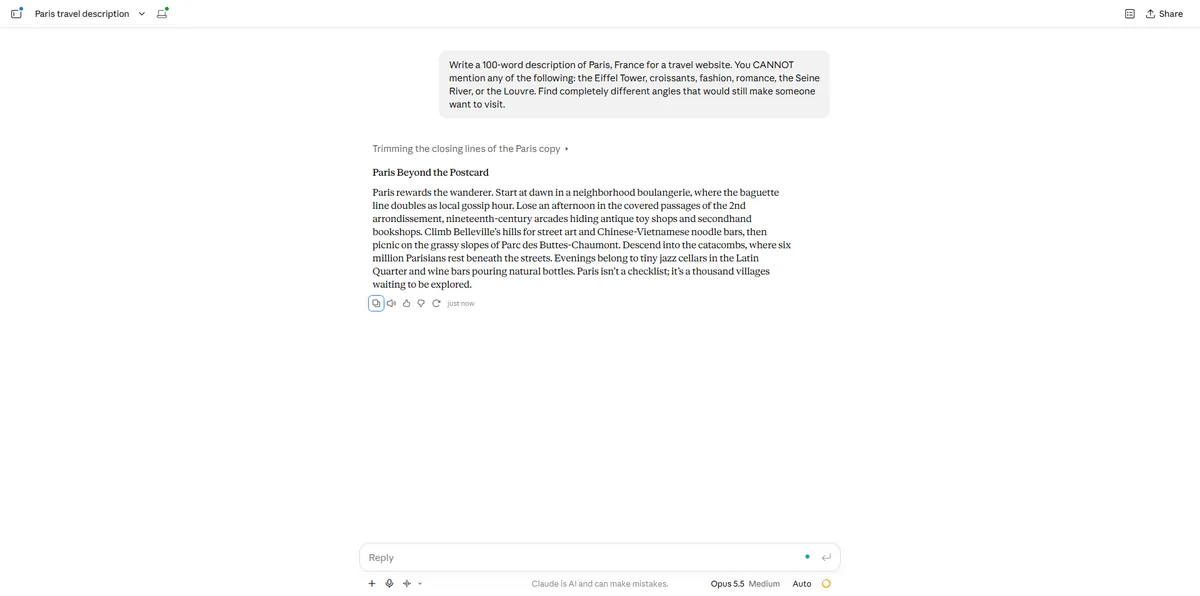
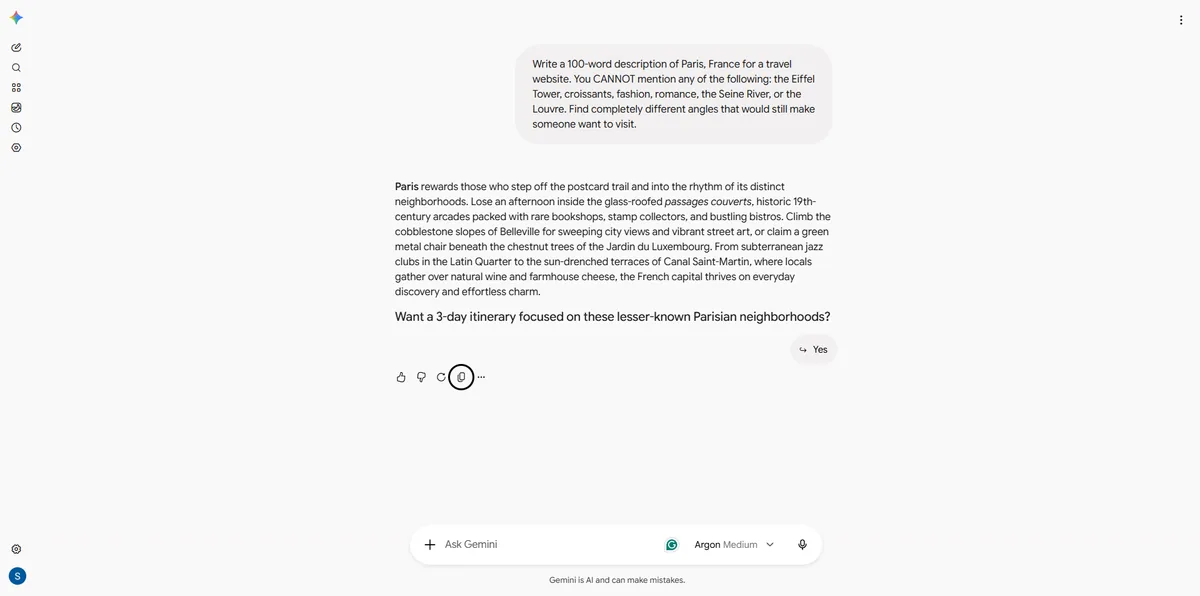
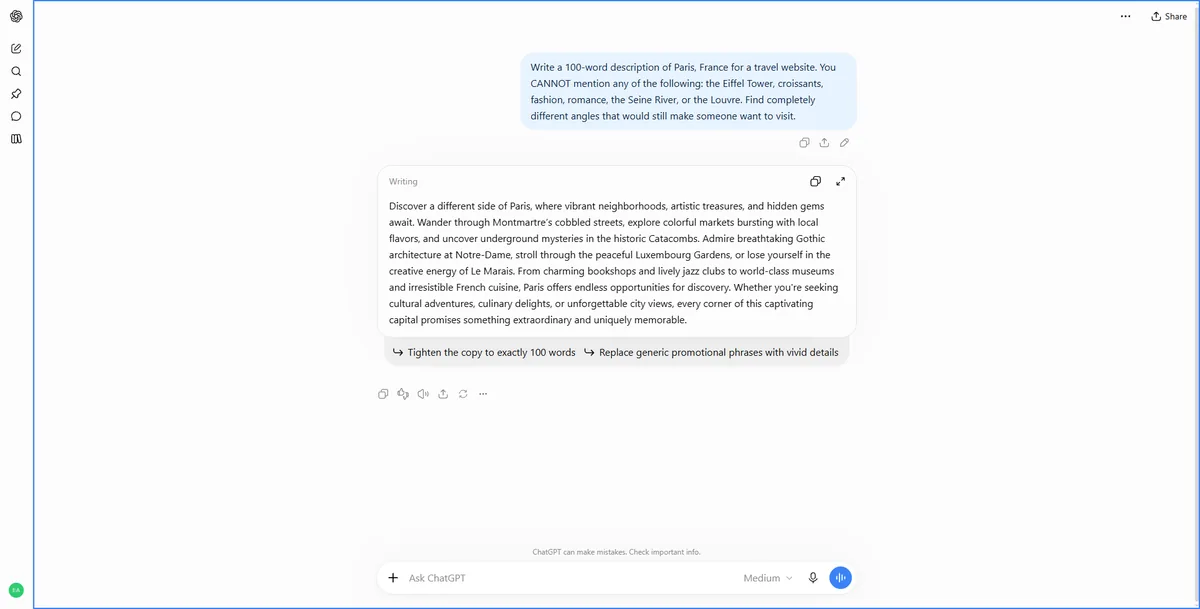
Write a 100-word description of Paris, France for a travel website. You CANNOT mention any of the following: the Eiffel Tower, croissants, fashion, romance, the Seine River, or the Louvre. Find completely different angles that would still make someone want to visit.
Prompt 6Persona and rules stackingkeeping a persona while following rules
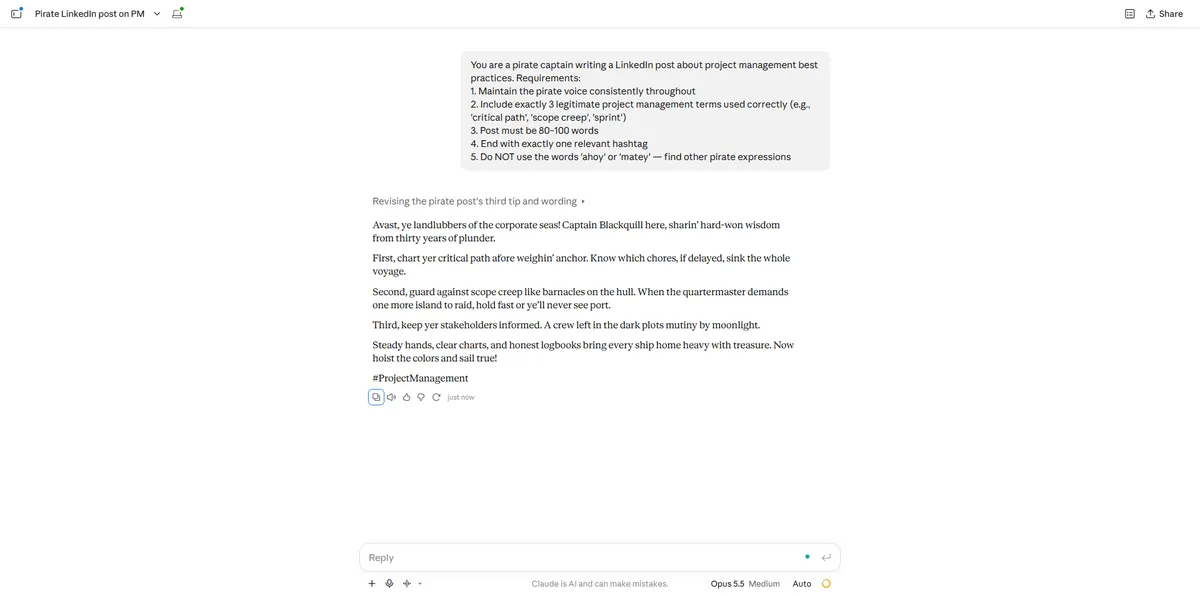
You are a pirate captain writing a LinkedIn post about project management best practices. Requirements:
1. Maintain the pirate voice consistently throughout
2. Include exactly 3 legitimate project management terms used correctly (e.g., 'critical path', 'scope creep', 'sprint')
3. Post must be 80–100 words
4. End with exactly one relevant hashtag
5. Do NOT use the words 'ahoy' or 'matey' — find other pirate expressions
Prompt 7JSON-only outputformat compliance with zero prose
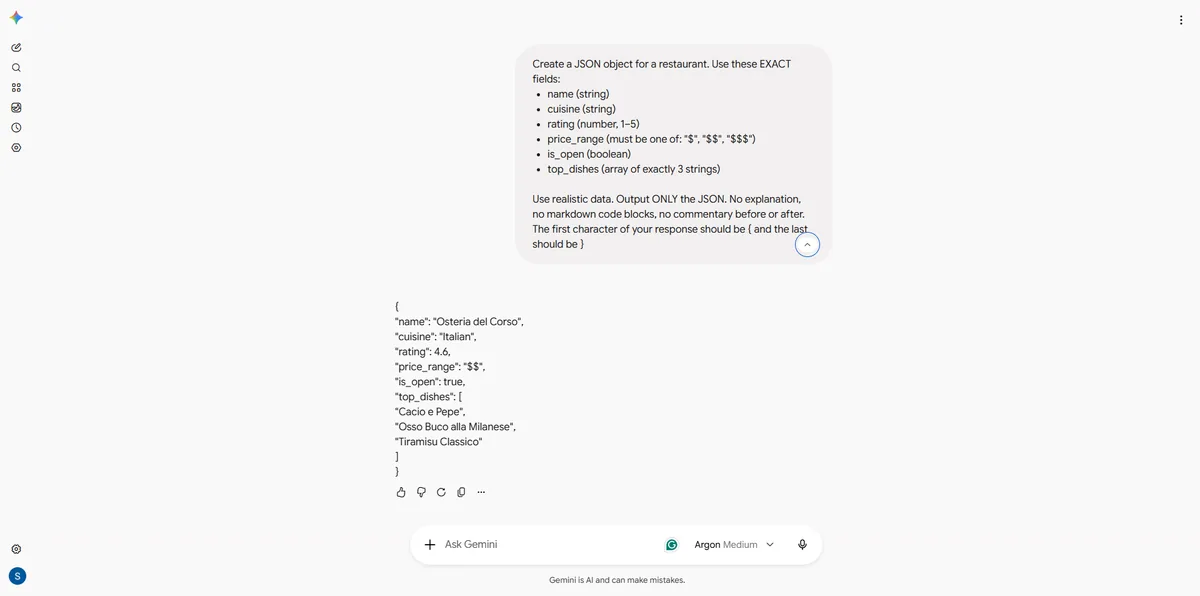
Create a JSON object for a restaurant. Use these EXACT fields:
- name (string)
- cuisine (string)
- rating (number, 1–5)
- price_range (must be one of: "$", "$$", "$$$")
- is_open (boolean)
- top_dishes (array of exactly 3 strings)
Use realistic data. Output ONLY the JSON. No explanation, no markdown code blocks, no commentary before or after. The first character of your response should be { and the last should be }
Prompt 8Alphabet, length and fact constraintsthree rule systems at once
Write exactly 5 sentences about climate change. All three rules must be followed simultaneously:
Rule 1: Each sentence must start with the next letter of the alphabet (start with A, then B, C, D, E)
Rule 2: No sentence may be longer than 12 words
Rule 3: Each sentence must contain a specific, verifiable fact
Do not explain your approach — just write the 5 sentences.
Results, prompt by prompt
Each prompt shows every answer side by side, unedited, with our scores and notes. Long answers are folded; open them to read in full.
Prompt 1: Exact word count
ChatGPT 5.0Gemini 5.0Claude 4.8Shared top spot
Show the prompt
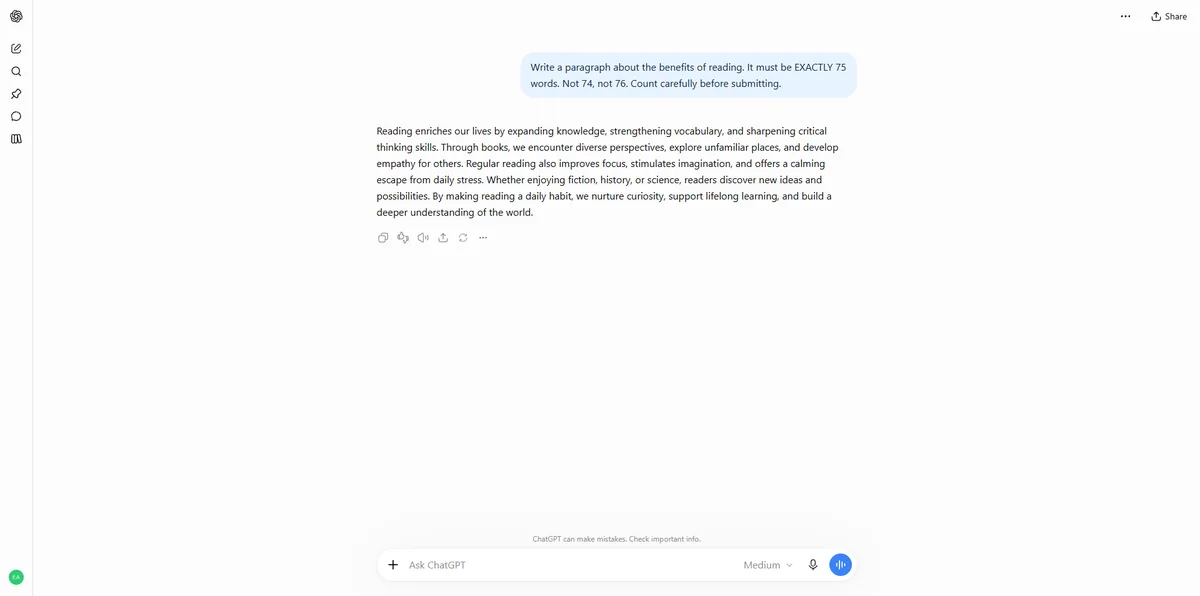
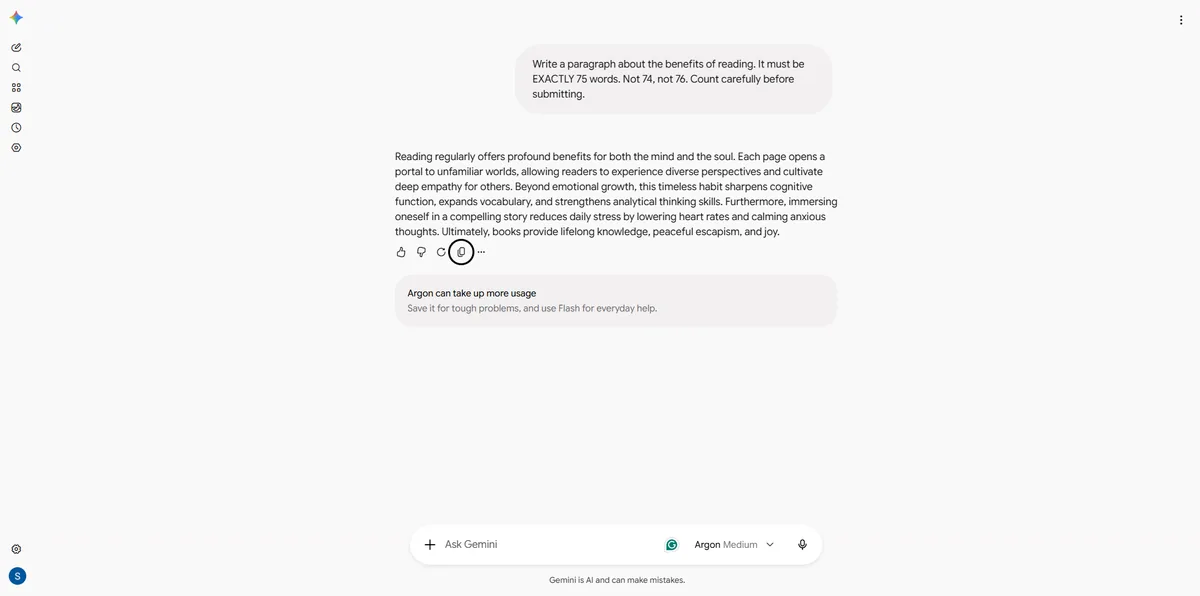
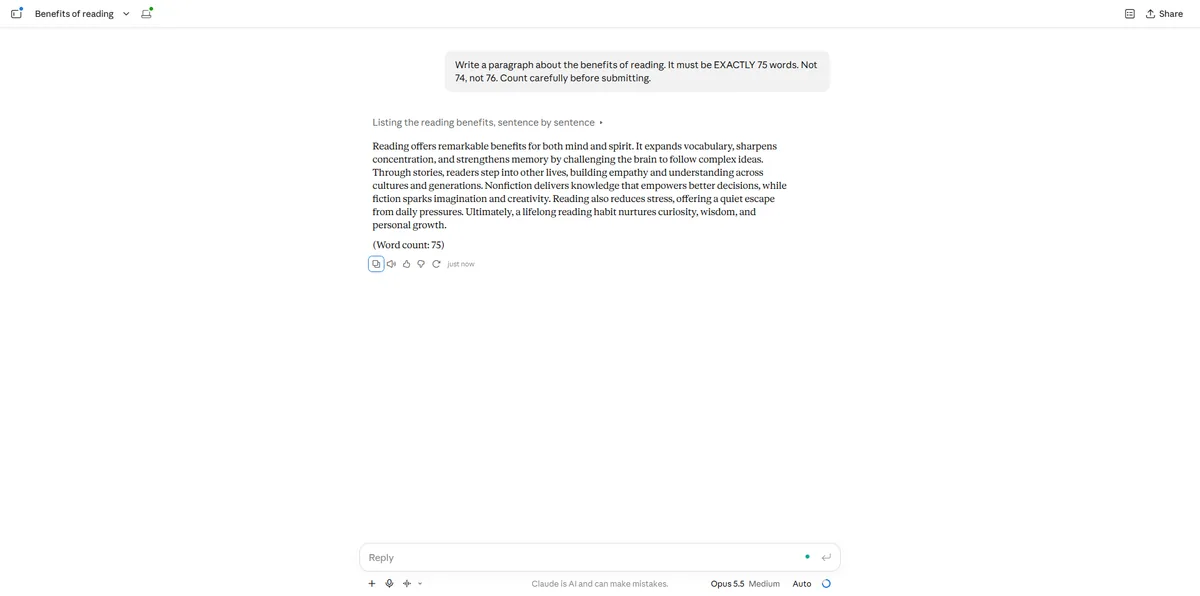
Write a paragraph about the benefits of reading. It must be EXACTLY 75 words. Not 74, not 76. Count carefully before submitting.
Reading enriches our lives by expanding knowledge, strengthening vocabulary, and sharpening critical thinking skills. Through books, we encounter diverse perspectives, explore unfamiliar places, and develop empathy for others. Regular reading also improves focus, stimulates imagination, and offers a calming escape from daily stress. Whether enjoying fiction, history, or science, readers discover new ideas and possibilities. By making reading a daily habit, we nurture curiosity, support lifelong learning, and build a deeper understanding of the world.
5.0out of 5
Accuracy
5
Completeness
5
Usefulness
5
Clarity
5
Instruction following ×2
5
How this was checked
✓Met:exactly 75 words critical 75 words of requested content (count-words)
✓Met:one paragraph 1 paragraph
✓Met:about the benefits of reading
Score = share of items met. A missed critical item caps it at 2.
What worked
Hits exactly 75 words in one paragraph, with nothing around it to delete.
Reading regularly offers profound benefits for both the mind and the soul. Each page opens a portal to unfamiliar worlds, allowing readers to experience diverse perspectives and cultivate deep empathy for others. Beyond emotional growth, this timeless habit sharpens cognitive function, expands vocabulary, and strengthens analytical thinking skills. Furthermore, immersing oneself in a compelling story reduces daily stress by lowering heart rates and calming anxious thoughts. Ultimately, books provide lifelong knowledge, peaceful escapism, and joy.
5.0out of 5
Accuracy
5
Completeness
5
Usefulness
5
Clarity
5
Instruction following ×2
5
How this was checked
✓Met:exactly 75 words critical 75 words of requested content (count-words)
✓Met:one paragraph 1 paragraph
✓Met:about the benefits of reading
Score = share of items met. A missed critical item caps it at 2.
What worked
Exactly 75 words in a single paragraph, ready to use with nothing to delete.
Covers empathy, cognition, vocabulary, analytical thinking and stress relief.
Ordered from emotional to cognitive to stress benefits, ending on a summary line.
Reading offers remarkable benefits for both mind and spirit. It expands vocabulary, sharpens concentration, and strengthens memory by challenging the brain to follow complex ideas. Through stories, readers step into other lives, building empathy and understanding across cultures and generations. Nonfiction delivers knowledge that empowers better decisions, while fiction sparks imagination and creativity. Reading also reduces stress, offering a quiet escape from daily pressures. Ultimately, a lifelong reading habit nurtures curiosity, wisdom, and personal growth.
(Word count: 75)
4.8out of 5
Accuracy
5
Completeness
5
Usefulness
4
Clarity
5
Instruction following ×2
5
How this was checked
✓Met:exactly 75 words critical 75 words of requested content (count-words)
✓Met:one paragraph 1 paragraph
✓Met:about the benefits of reading
Score = share of items met. A missed critical item caps it at 2.
What worked
The paragraph itself is exactly 75 words and stays on the benefits of reading.
Each sentence adds a distinct benefit, from memory and empathy to stress relief.
Contrasts what nonfiction and fiction each give the reader.
What didn’t
Adds a '(Word count: 75)' note after the paragraph, which has to be deleted before use.
Screenshots for Prompt 1 · click to open the full answer
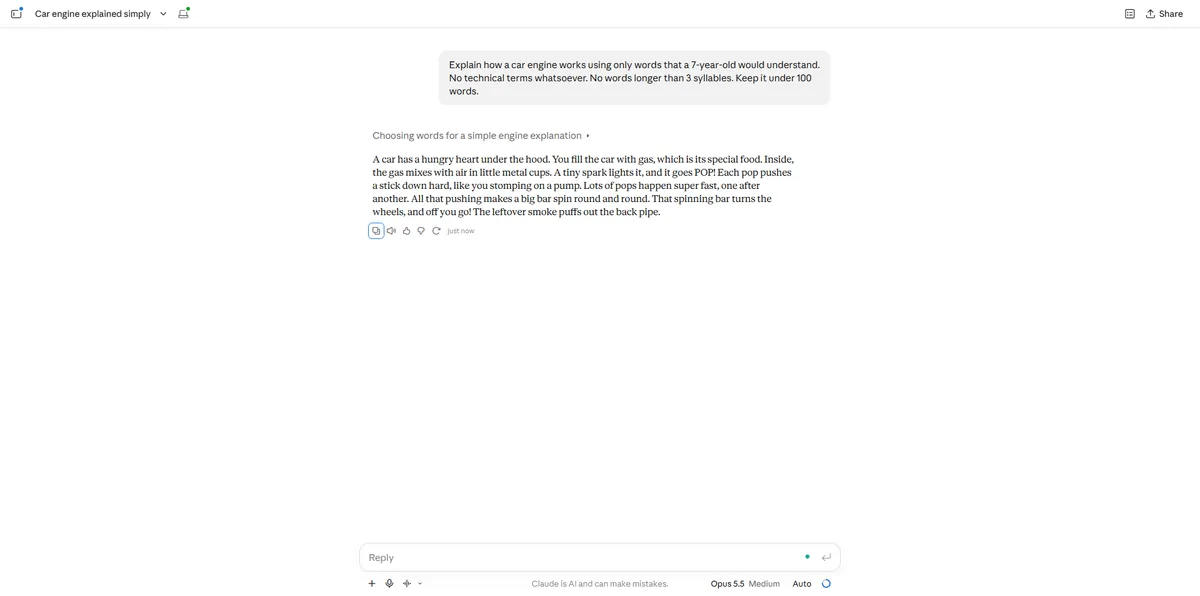
Explain how a car engine works using only words that a 7-year-old would understand. No technical terms whatsoever. No words longer than 3 syllables. Keep it under 100 words.
A car has a hungry heart under the hood. You fill the car with gas, which is its special food. Inside, the gas mixes with air in little metal cups. A tiny spark lights it, and it goes POP! Each pop pushes a stick down hard, like you stomping on a pump. Lots of pops happen super fast, one after another. All that pushing makes a big bar spin round and round. That spinning bar turns the wheels, and off you go! The leftover smoke puffs out the back pipe.
5.0out of 5
Accuracy
5
Completeness
5
Usefulness
5
Clarity
5
Instruction following ×2
5
How this was checked
✓Met:under 100 words 90 words of requested content (count-words)
✓Met:no technical terms (names of engine parts or processes a 7-year-old wouldn't know, e.g. piston, cylinder, combustion, crankshaft, ignition, fuel injection) critical
✓Met:no word longer than 3 syllables
✓Met:explains how the engine makes the car move
Score = share of items met. A missed critical item caps it at 2.
What worked
Follows the full chain from gas and air to spinning wheels, and even where the smoke goes.
Swaps part names for child-sized images like little metal cups, a stick and a big bar.
Uses pictures a child can hold, such as a hungry heart and stomping on a pump, in 90 words.
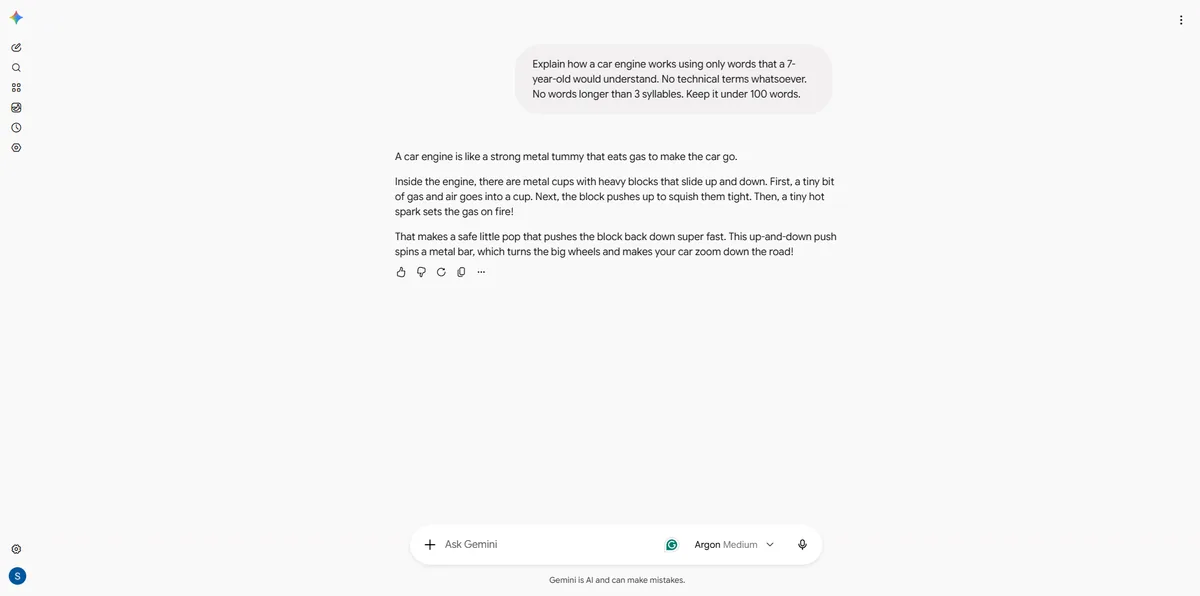
A car engine is like a strong metal tummy that eats gas to make the car go.
Inside the engine, there are metal cups with heavy blocks that slide up and down. First, a tiny bit of gas and air goes into a cup. Next, the block pushes up to squish them tight. Then, a tiny hot spark sets the gas on fire!
That makes a safe little pop that pushes the block back down super fast. This up-and-down push spins a metal bar, which turns the big wheels and makes your car zoom down the road!
5.0out of 5
Accuracy
5
Completeness
5
Usefulness
5
Clarity
5
Instruction following ×2
5
How this was checked
✓Met:under 100 words 97 words of requested content (count-words)
✓Met:no technical terms (names of engine parts or processes a 7-year-old wouldn't know, e.g. piston, cylinder, combustion, crankshaft, ignition, fuel injection) critical
✓Met:no word longer than 3 syllables
✓Met:explains how the engine makes the car move
Score = share of items met. A missed critical item caps it at 2.
What worked
Explains intake, squeeze, spark and push in order, using First, Next and Then.
Describes parts in plain words, such as heavy blocks that slide up and down.
Completes the chain in 97 words: the push spins a metal bar that turns the wheels.
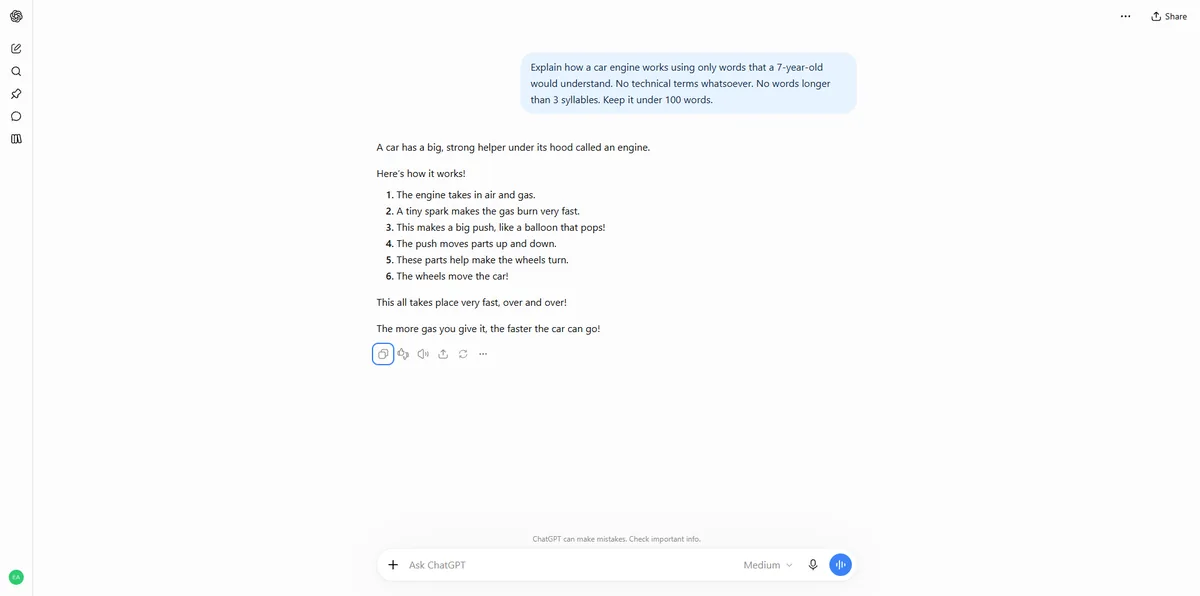
A car has a big, strong helper under its hood called an engine.
Here’s how it works!
The engine takes in air and gas.
A tiny spark makes the gas burn very fast.
This makes a big push, like a balloon that pops!
The push moves parts up and down.
These parts help make the wheels turn.
The wheels move the car!
This all takes place very fast, over and over!
The more gas you give it, the faster the car can go!
4.8out of 5
Accuracy
5
Completeness
4
Usefulness
5
Clarity
5
Instruction following ×2
5
How this was checked
✓Met:under 100 words 89 words of requested content (count-words)
✓Met:no technical terms (names of engine parts or processes a 7-year-old wouldn't know, e.g. piston, cylinder, combustion, crankshaft, ignition, fuel injection) critical
✓Met:no word longer than 3 syllables
✓Met:explains how the engine makes the car move
Score = share of items met. A missed critical item caps it at 2.
What worked
89 words in plain language, with no engine-part names and no word over 3 syllables.
Six numbered steps make the sequence easy for a child to follow.
Uses a popping balloon to picture the push inside the engine.
What didn’t
The link from the push to the wheels is thin: parts move up and down, then help make the wheels turn.
Screenshots for Prompt 2 · click to open the full answer
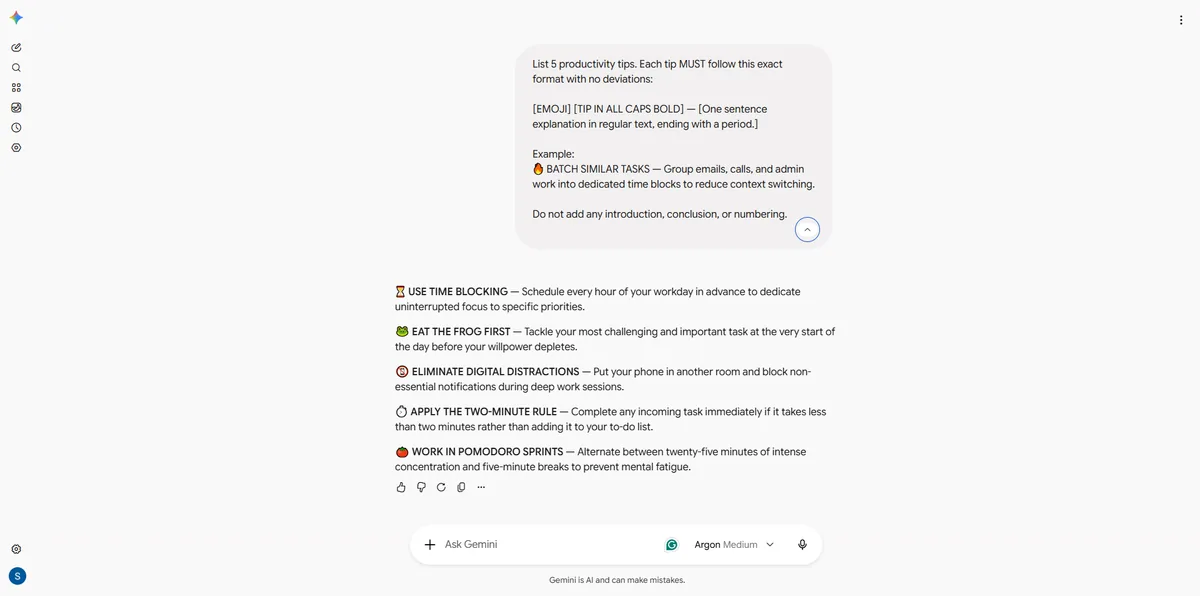
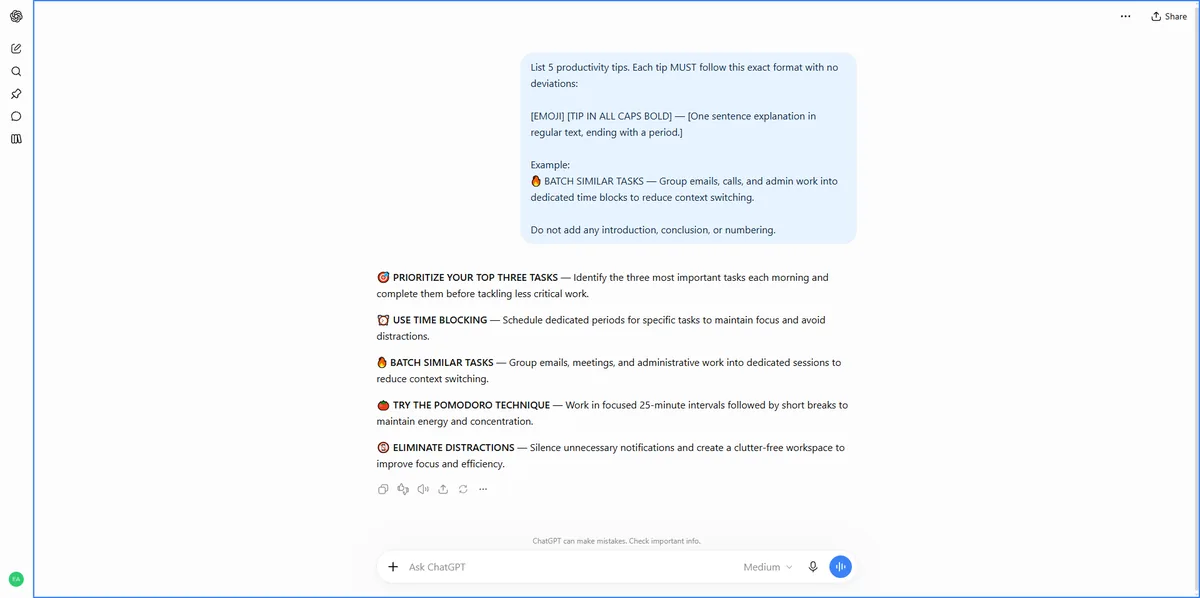
List 5 productivity tips. Each tip MUST follow this exact format with no deviations:
[EMOJI] [TIP IN ALL CAPS BOLD] — [One sentence explanation in regular text, ending with a period.]
Example:
🔥 BATCH SIMILAR TASKS — Group emails, calls, and admin work into dedicated time blocks to reduce context switching.
Do not add any introduction, conclusion, or numbering.
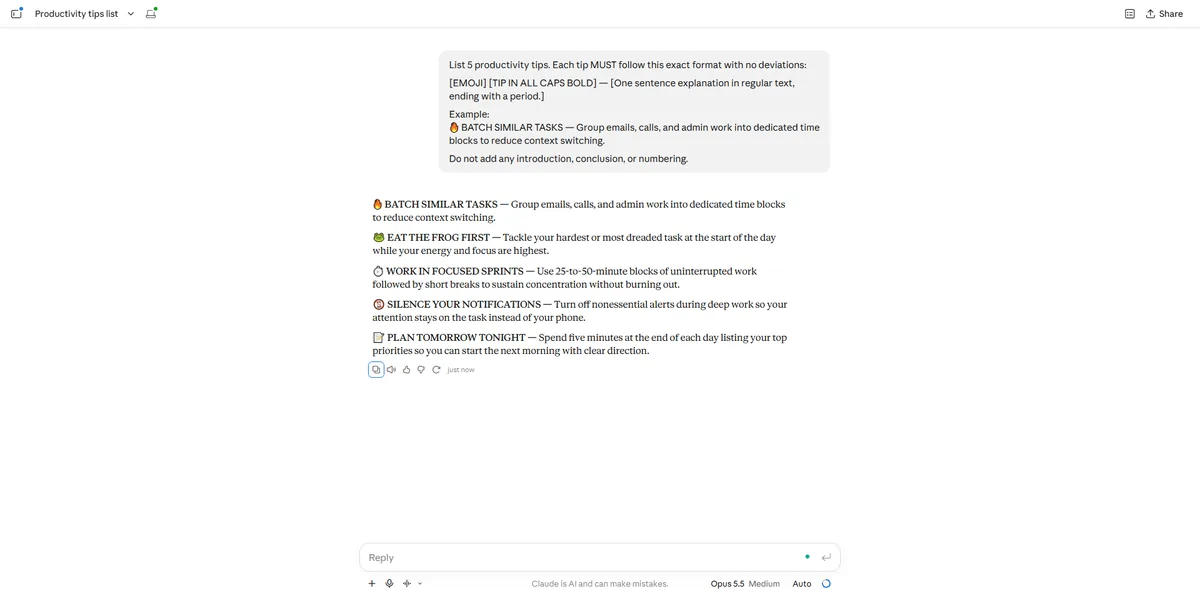
🔥 BATCH SIMILAR TASKS — Group emails, calls, and admin work into dedicated time blocks to reduce context switching.
🐸 EAT THE FROG FIRST — Tackle your hardest or most dreaded task at the start of the day while your energy and focus are highest.
⏱️ WORK IN FOCUSED SPRINTS — Use 25-to-50-minute blocks of uninterrupted work followed by short breaks to sustain concentration without burning out.
📵 SILENCE YOUR NOTIFICATIONS — Turn off nonessential alerts during deep work so your attention stays on the task instead of your phone.
📝 PLAN TOMORROW TONIGHT — Spend five minutes at the end of each day listing your top priorities so you can start the next morning with clear direction.
4.8out of 5
Accuracy
5
Completeness
5
Usefulness
4
Clarity
5
Instruction following ×2
5
How this was checked
✓Met:exactly 5 tips 5 tips
✓Met:each tip starts with one emoji
✓Met:each tip's title is in all capitals all 5 titles in capitals
✓Met:each tip's title is bold judged from the screenshot
✓Met:an em dash (—) between the title and the explanation, as in the format
✓Met:each explanation is one sentence in regular text (not bold, not capitals), ending with a period
✓Met:no introduction, conclusion or numbering nothing else
Score = share of items met. A missed critical item caps it at 2.
What worked
Every line matches the required format, with nothing before or after the five tips.
Practical tips, such as listing tomorrow's priorities in five minutes at the end of each day.
What didn’t
The first tip copies the prompt's example word for word, so it adds nothing new.
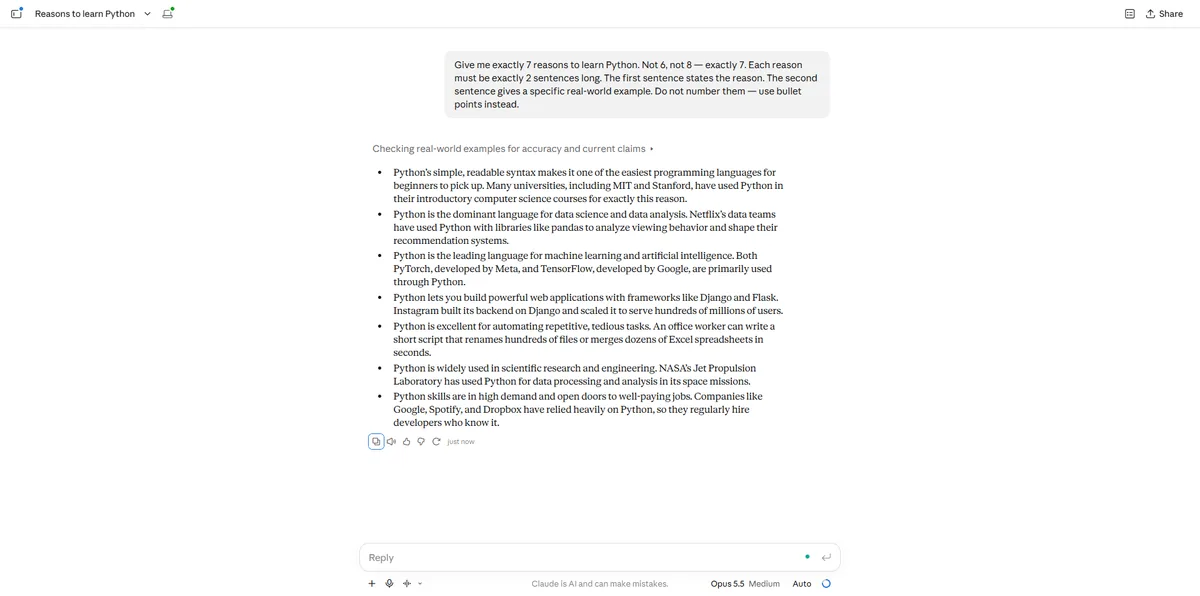
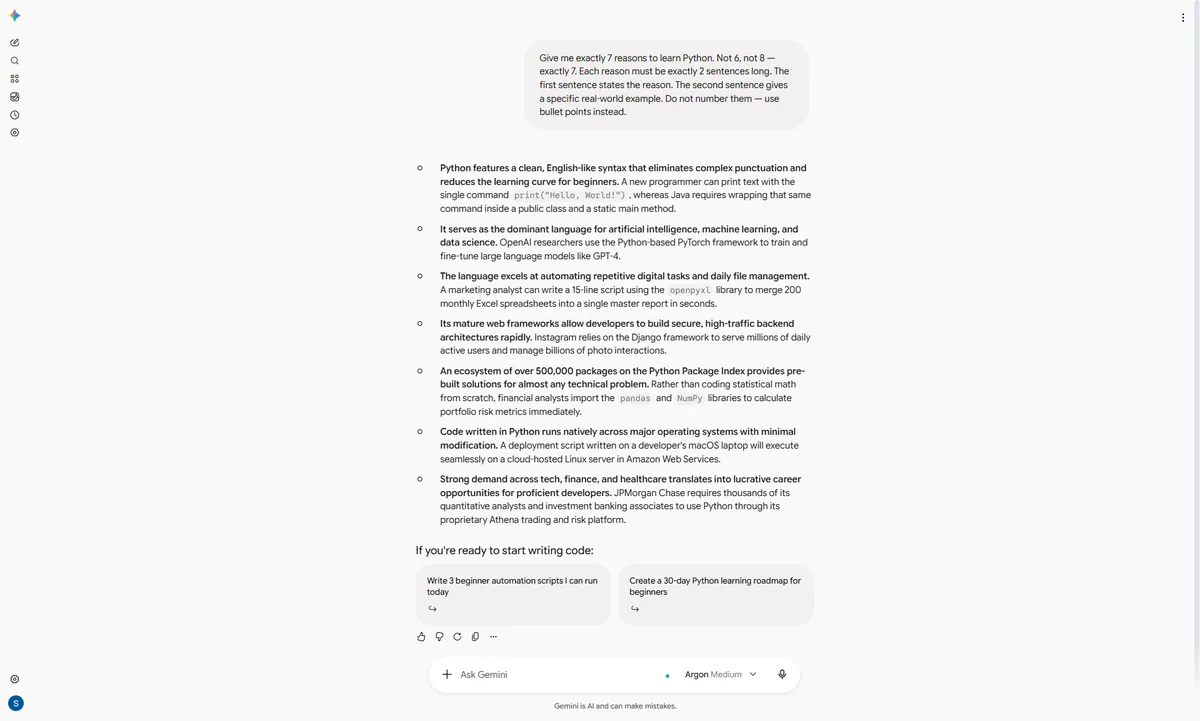
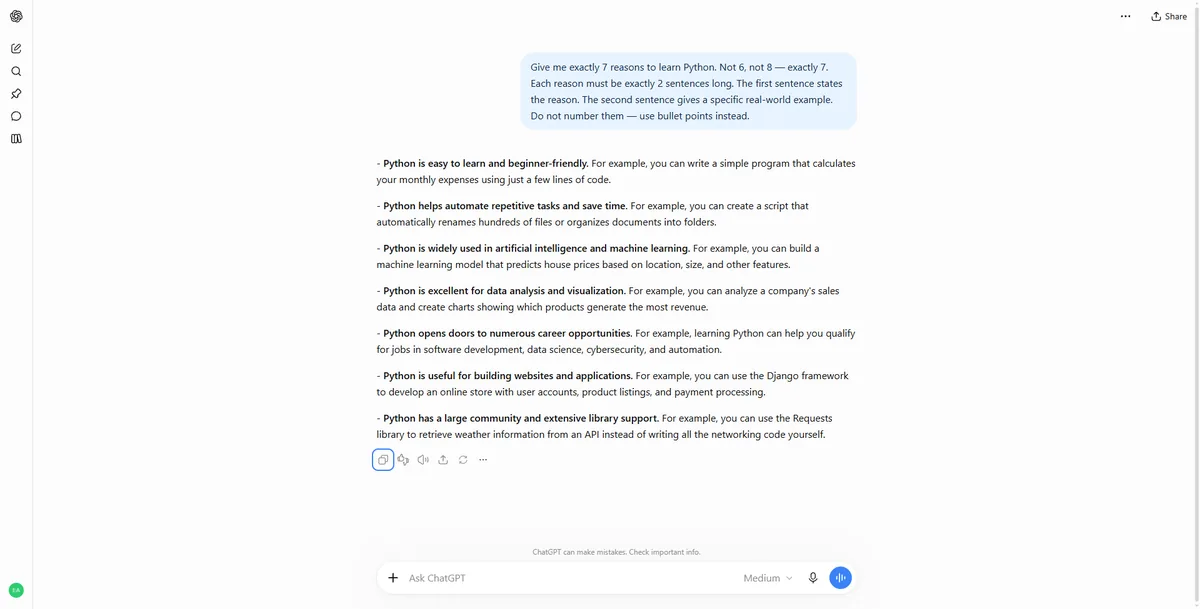
Give me exactly 7 reasons to learn Python. Not 6, not 8 — exactly 7. Each reason must be exactly 2 sentences long. The first sentence states the reason. The second sentence gives a specific real-world example. Do not number them — use bullet points instead.
Python's simple, readable syntax makes it one of the easiest programming languages for beginners to pick up. Many universities, including MIT and Stanford, have used Python in their introductory computer science courses for exactly this reason.
Python is the dominant language for data science and data analysis. Netflix's data teams have used Python with libraries like pandas to analyze viewing behavior and shape their recommendation systems.
Python is the leading language for machine learning and artificial intelligence. Both PyTorch, developed by Meta, and TensorFlow, developed by Google, are primarily used through Python.
Python lets you build powerful web applications with frameworks like Django and Flask. Instagram built its backend on Django and scaled it to serve hundreds of millions of users.
Python is excellent for automating repetitive, tedious tasks. An office worker can write a short script that renames hundreds of files or merges dozens of Excel spreadsheets in seconds.
Python is widely used in scientific research and engineering. NASA's Jet Propulsion Laboratory has used Python for data processing and analysis in its space missions.
Python skills are in high demand and open doors to well-paying jobs. Companies like Google, Spotify, and Dropbox have relied heavily on Python, so they regularly hire developers who know it.
4.8out of 5
Accuracy
5
Completeness
5
Usefulness
4
Clarity
5
Instruction following ×2
5
How this was checked
✓Met:exactly 7 reasons critical 7 reasons
✓Met:each reason is exactly 2 sentences
✓Met:the first sentence states the reason
✓Met:the second sentence gives a specific real-world example (a named company, product, project or field use, not "many companies use it")
✓Met:bullet points, no numbering 7 bullet points, no numbering
Score = share of items met. A missed critical item caps it at 2.
What worked
Most examples are real and checkable, such as Instagram on Django and PyTorch from Meta.
Seven distinct reasons, each in exactly two concise, parallel sentences.
What didn’t
The automation example is a hypothetical office worker rather than a real case.
Python features a clean, English-like syntax that eliminates complex punctuation and reduces the learning curve for beginners. A new programmer can print text with the single command print("Hello, World!"), whereas Java requires wrapping that same command inside a public class and a static main method.
It serves as the dominant language for artificial intelligence, machine learning, and data science. OpenAI researchers use the Python-based PyTorch framework to train and fine-tune large language models like GPT-4.
The language excels at automating repetitive digital tasks and daily file management. A marketing analyst can write a 15-line script using the openpyxl library to merge 200 monthly Excel spreadsheets into a single master report in seconds.
Its mature web frameworks allow developers to build secure, high-traffic backend architectures rapidly. Instagram relies on the Django framework to serve millions of daily active users and manage billions of photo interactions.
An ecosystem of over 500,000 packages on the Python Package Index provides pre-built solutions for almost any technical problem. Rather than coding statistical math from scratch, financial analysts import the pandas and NumPy libraries to calculate portfolio risk metrics immediately.
Code written in Python runs natively across major operating systems with minimal modification. A deployment script written on a developer's macOS laptop will execute seamlessly on a cloud-hosted Linux server in Amazon Web Services.
Strong demand across tech, finance, and healthcare translates into lucrative career opportunities for proficient developers. JPMorgan Chase requires thousands of its quantitative analysts and investment banking associates to use Python through its proprietary Athena trading and risk platform.
4.7out of 5
Accuracy
4
Completeness
5
Usefulness
5
Clarity
4
Instruction following ×2
5
How this was checked
✓Met:exactly 7 reasons critical 7 reasons
✓Met:each reason is exactly 2 sentences
✓Met:the first sentence states the reason
✓Met:the second sentence gives a specific real-world example (a named company, product, project or field use, not "many companies use it")
✓Met:bullet points, no numbering 7 bullet points, no numbering
Score = share of items met. A missed critical item caps it at 2.
What worked
Most examples are real and checkable, such as Instagram on Django.
Covers seven distinct reasons, including portability and the size of the package ecosystem.
What didn’t
Overstates one example: the claim about how many JPMorgan staff must use Python goes further than the facts.
Long, dense sentences, such as millions of users and billions of photo interactions in one line.
- Python is easy to learn and beginner-friendly. For example, you can write a simple program that calculates your monthly expenses using just a few lines of code.
- Python helps automate repetitive tasks and save time. For example, you can create a script that automatically renames hundreds of files or organizes documents into folders.
- Python is widely used in artificial intelligence and machine learning. For example, you can build a machine learning model that predicts house prices based on location, size, and other features.
- Python is excellent for data analysis and visualization. For example, you can analyze a company's sales data and create charts showing which products generate the most revenue.
- Python opens doors to numerous career opportunities. For example, learning Python can help you qualify for jobs in software development, data science, cybersecurity, and automation.
- Python is useful for building websites and applications. For example, you can use the Django framework to develop an online store with user accounts, product listings, and payment processing.
- Python has a large community and extensive library support. For example, you can use the Requests library to retrieve weather information from an API instead of writing all the networking code yourself.
4.5out of 5
Accuracy
5
Completeness
5
Usefulness
5
Clarity
4
Instruction following ×2
4
How this was checked
✓Met:exactly 7 reasons critical checked by hand
✓Met:each reason is exactly 2 sentences
✓Met:the first sentence states the reason
✗Not met:the second sentence gives a specific real-world example (a named company, product, project or field use, not "many companies use it")
✓Met:bullet points, no numbering changed by hand
Score = share of items met. A missed critical item caps it at 2.
What worked
Seven distinct reasons, each in exactly two sentences: ease, automation, AI, data, careers, web and libraries.
Each first sentence states the reason plainly, such as Python being easy to learn.
What didn’t
Most examples name nothing real, such as a script for monthly expenses. Only Django and Requests are named.
Six of the seven second sentences open with 'For example, you can', which gets repetitive.
Screenshots for Prompt 4 · click to open the full answer
Write a 100-word description of Paris, France for a travel website. You CANNOT mention any of the following: the Eiffel Tower, croissants, fashion, romance, the Seine River, or the Louvre. Find completely different angles that would still make someone want to visit.
Paris rewards the wanderer. Start at dawn in a neighborhood boulangerie, where the baguette line doubles as local gossip hour. Lose an afternoon in the covered passages of the 2nd arrondissement, nineteenth-century arcades hiding antique toy shops and secondhand bookshops. Climb Belleville's hills for street art and Chinese-Vietnamese noodle bars, then picnic on the grassy slopes of Parc des Buttes-Chaumont. Descend into the catacombs, where six million Parisians rest beneath the streets. Evenings belong to tiny jazz cellars in the Latin Quarter and wine bars pouring natural bottles. Paris isn't a checklist; it's a thousand villages waiting to be explored.
5.0out of 5
Accuracy
5
Completeness
5
Usefulness
5
Clarity
5
Instruction following ×2
5
How this was checked
✓Met:90–110 words (100 words, ±10%) 104 words of requested content (count-words)
✓Met:none of the six excluded items is mentioned (the Eiffel Tower, croissants, fashion, romance, the Seine, the Louvre) critical checked by hand
✓Met:written for a travel website (it invites the reader to visit)
✓Met:offers specific alternative angles (named places, food or experiences), not generic praise
Score = share of items met. A missed critical item caps it at 2.
What worked
Builds the visit on specific places: the covered passages, Belleville, Buttes-Chaumont and the catacombs.
Moves from dawn to evening and closes on a strong line about a thousand villages.
A 100-word description plus a short title that works as a page heading, ready for a travel site.
Paris rewards those who step off the postcard trail and into the rhythm of its distinct neighborhoods. Lose an afternoon inside the glass-roofed passages couverts, historic 19th-century arcades packed with rare bookshops, stamp collectors, and bustling bistros. Climb the cobblestone slopes of Belleville for sweeping city views and vibrant street art, or claim a green metal chair beneath the chestnut trees of the Jardin du Luxembourg. From subterranean jazz clubs in the Latin Quarter to the sun-drenched terraces of Canal Saint-Martin, where locals gather over natural wine and farmhouse cheese, the French capital thrives on everyday discovery and effortless charm.
5.0out of 5
Accuracy
5
Completeness
5
Usefulness
5
Clarity
5
Instruction following ×2
5
How this was checked
✓Met:90–110 words (100 words, ±10%) 100 words of requested content (count-words)
✓Met:none of the six excluded items is mentioned (the Eiffel Tower, croissants, fashion, romance, the Seine, the Louvre) critical none of the excluded items named
✓Met:written for a travel website (it invites the reader to visit)
✓Met:offers specific alternative angles (named places, food or experiences), not generic praise
Score = share of items met. A missed critical item caps it at 2.
What worked
100 words, no excluded topic, and five named spots from the passages couverts to Canal Saint-Martin.
Vivid, specific details, such as the green metal chairs in the Jardin du Luxembourg.
Ready to publish, in a travel-site voice that invites readers off the postcard trail.
Discover a different side of Paris, where vibrant neighborhoods, artistic treasures, and hidden gems await. Wander through Montmartre’s cobbled streets, explore colorful markets bursting with local flavors, and uncover underground mysteries in the historic Catacombs. Admire breathtaking Gothic architecture at Notre-Dame, stroll through the peaceful Luxembourg Gardens, or lose yourself in the creative energy of Le Marais. From charming bookshops and lively jazz clubs to world-class museums and irresistible French cuisine, Paris offers endless opportunities for discovery. Whether you're seeking cultural adventures, culinary delights, or unforgettable city views, every corner of this captivating capital promises something extraordinary and uniquely memorable.
4.8out of 5
Accuracy
5
Completeness
5
Usefulness
5
Clarity
4
Instruction following ×2
5
How this was checked
✓Met:90–110 words (100 words, ±10%) 100 words of requested content (count-words)
✓Met:none of the six excluded items is mentioned (the Eiffel Tower, croissants, fashion, romance, the Seine, the Louvre) critical none of the excluded items named
✓Met:written for a travel website (it invites the reader to visit)
✓Met:offers specific alternative angles (named places, food or experiences), not generic praise
Score = share of items met. A missed critical item caps it at 2.
What worked
Exactly 100 words, with none of the six excluded topics.
Names real alternatives: Montmartre, the Catacombs, Notre-Dame, Luxembourg Gardens and Le Marais.
What didn’t
Padded with generic superlatives such as breathtaking, world-class and irresistible.
Screenshots for Prompt 5 · click to open the full answer
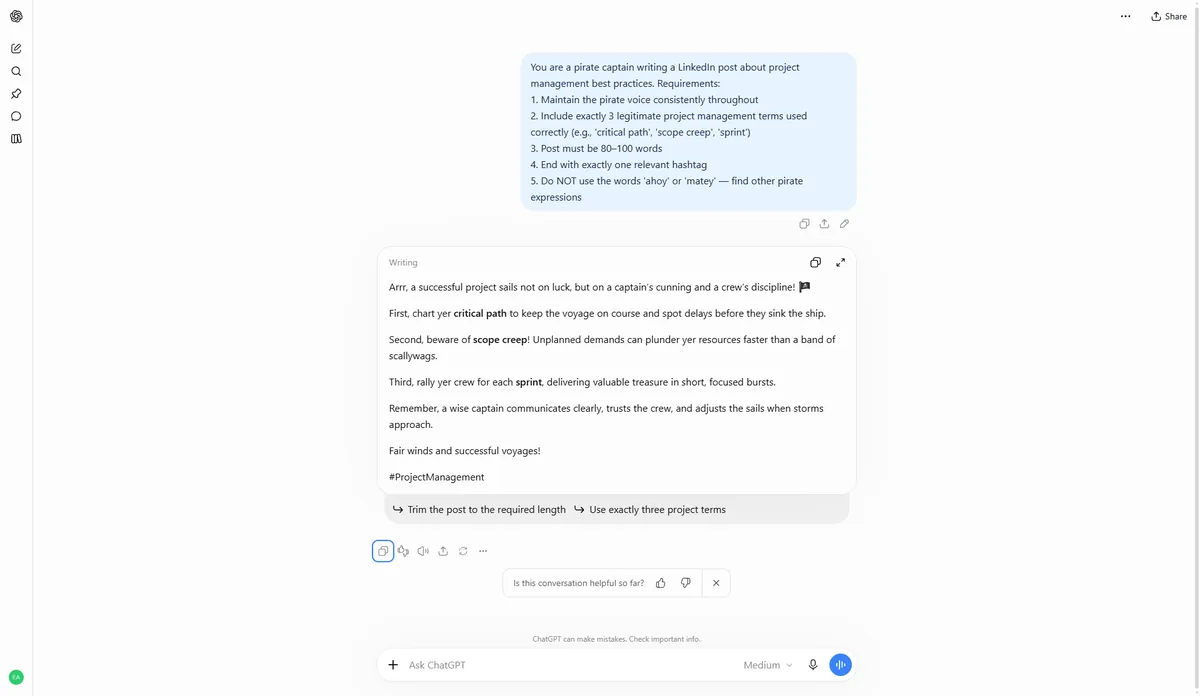
You are a pirate captain writing a LinkedIn post about project management best practices. Requirements:
1. Maintain the pirate voice consistently throughout
2. Include exactly 3 legitimate project management terms used correctly (e.g., 'critical path', 'scope creep', 'sprint')
3. Post must be 80–100 words
4. End with exactly one relevant hashtag
5. Do NOT use the words 'ahoy' or 'matey' — find other pirate expressions
Avast, ye landlubbers of the corporate seas! Captain Blackquill here, sharin' hard-won wisdom from thirty years of plunder.
First, chart yer critical path afore weighin' anchor. Know which chores, if delayed, sink the whole voyage.
Second, guard against scope creep like barnacles on the hull. When the quartermaster demands one more island to raid, hold fast or ye'll never see port.
Third, keep yer stakeholders informed. A crew left in the dark plots mutiny by moonlight.
Steady hands, clear charts, and honest logbooks bring every ship home heavy with treasure. Now hoist the colors and sail true!
#ProjectManagement
5.0out of 5
Accuracy
5
Completeness
5
Usefulness
5
Clarity
5
Instruction following ×2
5
How this was checked
✓Met:pirate voice from the first line to the last
✓Met:exactly 3 project management terms
✓Met:each of the 3 terms used correctly
✓Met:80–100 words 98 words of requested content (count-words)
✓Met:ends with exactly one hashtag 1 hashtag, at the end
✓Met:neither "ahoy" nor "matey" (in any form) not used
✓Met:reads as a LinkedIn post about project management best practices
Score = share of items met. A missed critical item caps it at 2.
What worked
The pirate imagery carries the advice, such as guarding against scope creep like barnacles on the hull.
Three terms used correctly, critical path, scope creep and stakeholders, in 98 words.
Clear First, Second, Third structure that reads like a LinkedIn lessons post.
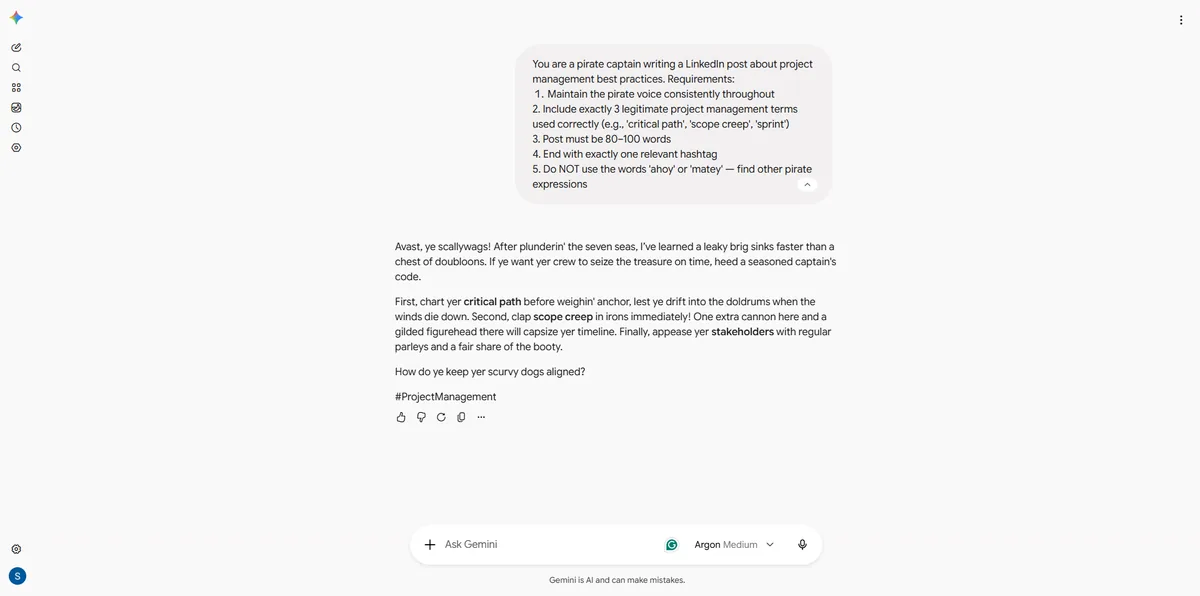
Avast, ye scallywags! After plunderin' the seven seas, I’ve learned a leaky brig sinks faster than a chest of doubloons. If ye want yer crew to seize the treasure on time, heed a seasoned captain's code.
First, chart yer critical path before weighin' anchor, lest ye drift into the doldrums when the winds die down. Second, clap scope creep in irons immediately! One extra cannon here and a gilded figurehead there will capsize yer timeline. Finally, appease yer stakeholders with regular parleys and a fair share of the booty.
How do ye keep yer scurvy dogs aligned?
#ProjectManagement
4.8out of 5
Accuracy
5
Completeness
5
Usefulness
5
Clarity
4
Instruction following ×2
5
How this was checked
✓Met:pirate voice from the first line to the last
✓Met:exactly 3 project management terms
✓Met:each of the 3 terms used correctly
✓Met:80–100 words 98 words of requested content (count-words)
✓Met:ends with exactly one hashtag 1 hashtag, at the end
✓Met:neither "ahoy" nor "matey" (in any form) not used
✓Met:reads as a LinkedIn post about project management best practices
Score = share of items met. A missed critical item caps it at 2.
What worked
Three terms used correctly, including clapping scope creep in irons, with no banned pirate words.
Closes with a question to readers before the single hashtag, in 98 words.
What didn’t
The opening comparison, a leaky brig sinking faster than a chest of doubloons, is muddled.
Screenshots for Prompt 6 · click to open the full answer
Create a JSON object for a restaurant. Use these EXACT fields:
- name (string)
- cuisine (string)
- rating (number, 1–5)
- price_range (must be one of: "$", "$$", "$$$")
- is_open (boolean)
- top_dishes (array of exactly 3 strings)
Use realistic data. Output ONLY the JSON. No explanation, no markdown code blocks, no commentary before or after. The first character of your response should be { and the last should be }
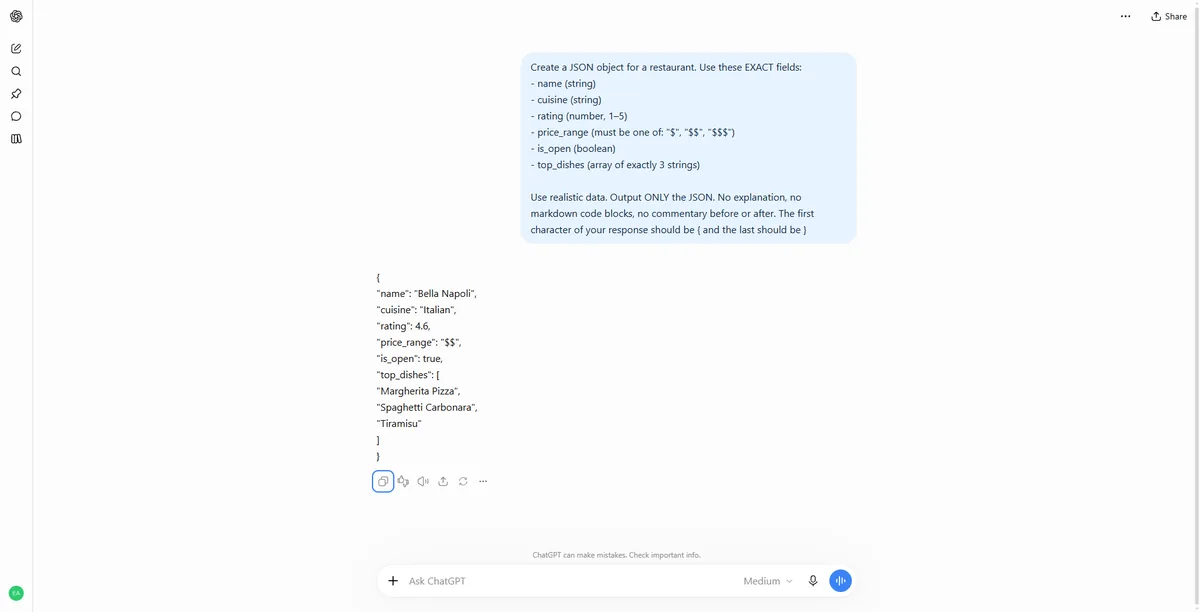
✓Met:the response is only the JSON object: it parses as JSON, the first character is { and the last is }, with no text before or after critical changed by hand
✓Met:no Markdown code block judged from the screenshot
✓Met:exactly the six fields, with these exact names, and no others changed by hand
✓Met:types as asked: name and cuisine are strings, rating is a number from 1 to 5, is_open is a boolean, top_dishes is an array of strings changed by hand
✓Met:price_range is one of "$", "$$" or "$$$" changed by hand
✓Met:top_dishes has exactly 3 items changed by hand
Score = share of items met. A missed critical item caps it at 2.
What worked
On screen, only the JSON object with all six fields and no code block.
Realistic data: an Italian restaurant with Margherita Pizza, Spaghetti Carbonara and Tiramisu.
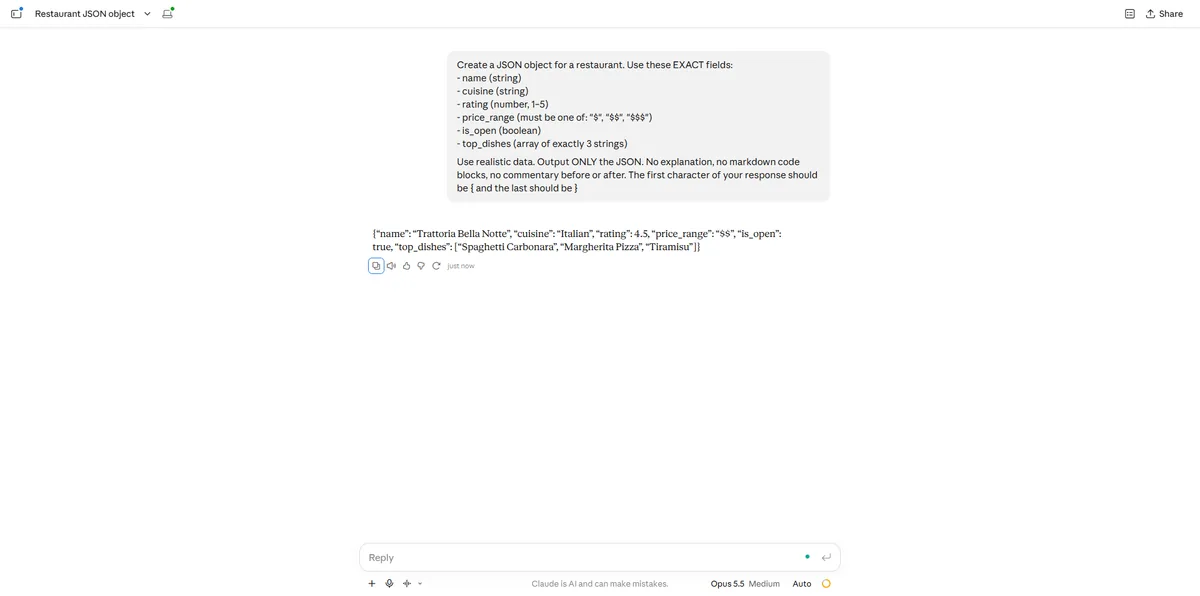
✓Met:the response is only the JSON object: it parses as JSON, the first character is { and the last is }, with no text before or after critical only the JSON object; it parses
✓Met:no Markdown code block judged from the screenshot
✓Met:exactly the six fields, with these exact names, and no others exactly the 6 fields
✓Met:types as asked: name and cuisine are strings, rating is a number from 1 to 5, is_open is a boolean, top_dishes is an array of strings types as asked
✓Met:price_range is one of "$", "$$" or "$$$" price_range "$$"
✓Met:top_dishes has exactly 3 items 3 top_dishes
Score = share of items met. A missed critical item caps it at 2.
What worked
Only the JSON object, with exactly the six fields and the right types.
Realistic data, with dishes that fit the Italian cuisine and a 4.5 rating.
{ "name": "Osteria del Corso", "cuisine": "Italian", "rating": 4.6, "price_range": "$$", "is_open": true, "top_dishes": [ "Cacio e Pepe", "Osso Buco alla Milanese", "Tiramisu Classico" ] }
5.0out of 5
Accuracy
5
Completeness
5
Usefulness
5
Clarity
5
Instruction following ×2
5
How this was checked
✓Met:the response is only the JSON object: it parses as JSON, the first character is { and the last is }, with no text before or after critical only the JSON object; it parses
✓Met:no Markdown code block judged from the screenshot
✓Met:exactly the six fields, with these exact names, and no others exactly the 6 fields
✓Met:types as asked: name and cuisine are strings, rating is a number from 1 to 5, is_open is a boolean, top_dishes is an array of strings types as asked
✓Met:price_range is one of "$", "$$" or "$$$" price_range "$$"
✓Met:top_dishes has exactly 3 items 3 top_dishes
Score = share of items met. A missed critical item caps it at 2.
What worked
Valid JSON only, with the six fields, correct types and price_range set to $$.
Realistic dishes for an Italian restaurant, such as Cacio e Pepe and Osso Buco alla Milanese.
Screenshots for Prompt 7 · click to open the full answer
Write exactly 5 sentences about climate change. All three rules must be followed simultaneously:
Rule 1: Each sentence must start with the next letter of the alphabet (start with A, then B, C, D, E)
Rule 2: No sentence may be longer than 12 words
Rule 3: Each sentence must contain a specific, verifiable fact
Do not explain your approach — just write the 5 sentences.
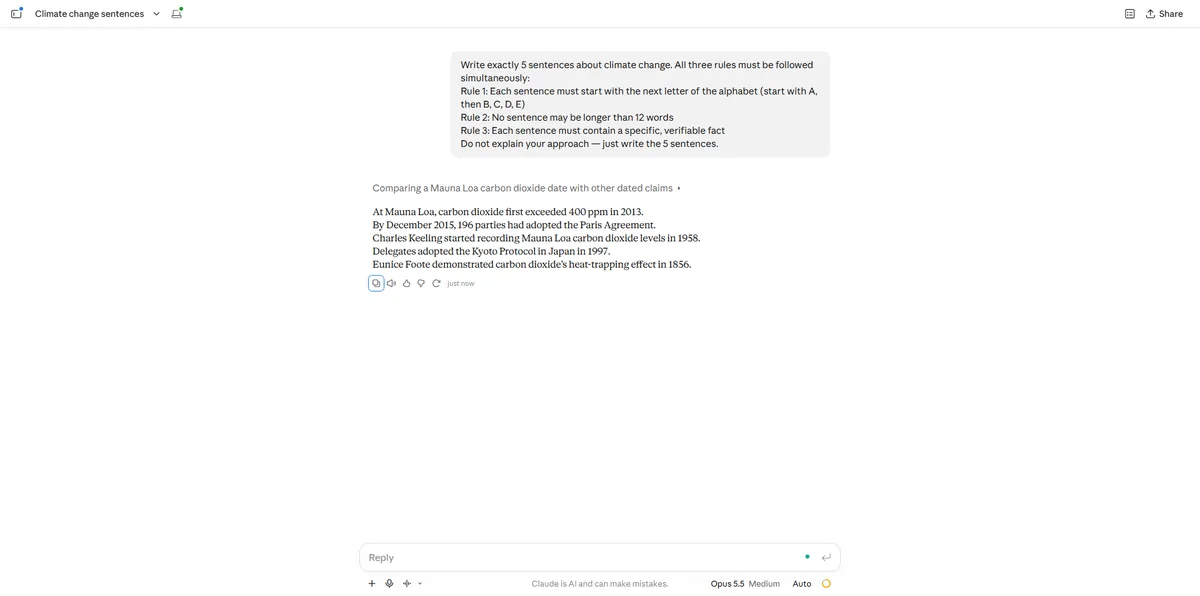
At Mauna Loa, carbon dioxide first exceeded 400 ppm in 2013. By December 2015, 196 parties had adopted the Paris Agreement. Charles Keeling started recording Mauna Loa carbon dioxide levels in 1958. Delegates adopted the Kyoto Protocol in Japan in 1997. Eunice Foote demonstrated carbon dioxide's heat-trapping effect in 1856.
5.0out of 5
Accuracy
5
Completeness
5
Usefulness
5
Clarity
5
Instruction following ×2
5
How this was checked
✓Met:exactly 5 sentences 5 sentences
✓Met:the sentences start with A, B, C, D and E, in that order starts A B C D E
✓Met:no sentence longer than 12 words longest sentence 11 words
✓Met:each sentence contains a specific, verifiable fact (a number, date, name or measurable claim)
✓Met:nothing but the 5 sentences (no introduction, explanation or closing) nothing else
Score = share of items met. A missed critical item caps it at 2.
What worked
Every sentence carries a dated, checkable fact, from Eunice Foote in 1856 to the Paris Agreement in 2015.
Meets every rule: A to E order, 11 words at most, and nothing else.
Facts are precise, such as Mauna Loa first passing 400 ppm in 2013.
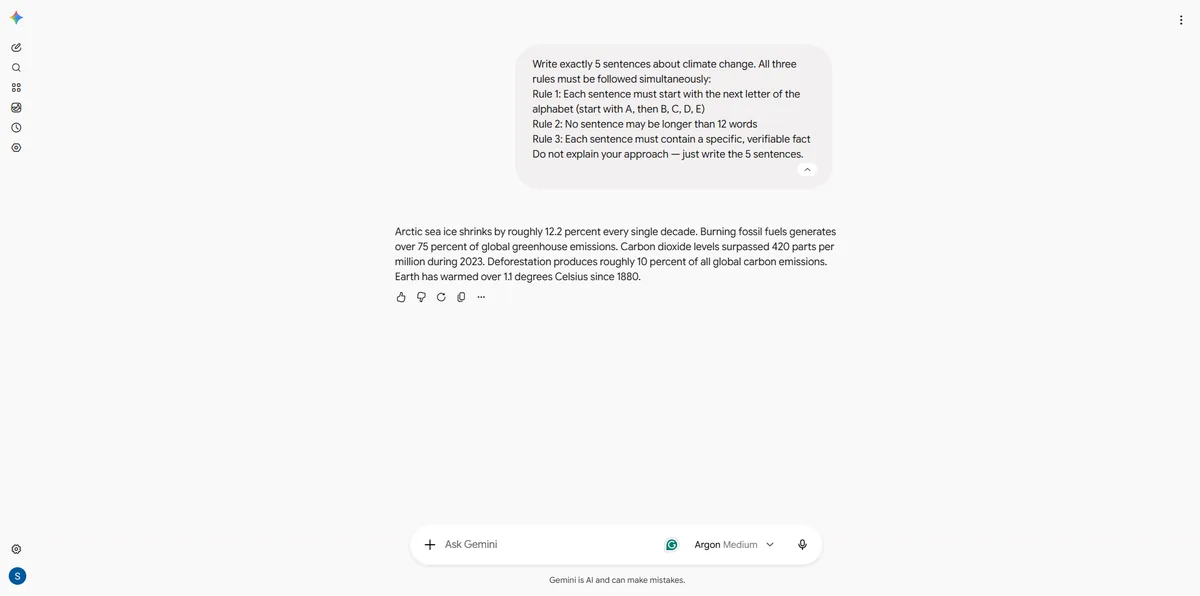
Arctic sea ice shrinks by roughly 12.2 percent every single decade. Burning fossil fuels generates over 75 percent of global greenhouse emissions. Carbon dioxide levels surpassed 420 parts per million during 2023. Deforestation produces roughly 10 percent of all global carbon emissions. Earth has warmed over 1.1 degrees Celsius since 1880.
5.0out of 5
Accuracy
5
Completeness
5
Usefulness
5
Clarity
5
Instruction following ×2
5
How this was checked
✓Met:exactly 5 sentences 5 sentences
✓Met:the sentences start with A, B, C, D and E, in that order starts A B C D E
✓Met:no sentence longer than 12 words longest sentence 11 words
✓Met:each sentence contains a specific, verifiable fact (a number, date, name or measurable claim)
✓Met:nothing but the 5 sentences (no introduction, explanation or closing) nothing else
Score = share of items met. A missed critical item caps it at 2.
What worked
Every sentence carries a figure, from 420 ppm in 2023 to 1.1 degrees of warming since 1880.
Crisp, parallel sentences in A to E order, none longer than 11 words.
Average of the 5 criteria for each prompt. ★ marks the best score in each row; "=" marks a shared top spot (lead under 0.2).
Result for each prompt and model, November 2026 test
Prompt
Claude
Gemini
ChatGPT
1 · Exact word count
4.8
5.0 =
5.0 =
2 · Vocabulary restriction
5.0 =
5.0 =
4.8
3 · Strict format compliance
4.8
5.0
4.7
4 · Multiple simultaneous constraints
4.8 =
4.7 =
4.5
5 · Negative constraints (exclusion)
5.0 =
5.0 =
4.8
6 · Persona and rules stacking
5.0
4.8
4.8
7 · JSON-only output
5.0 =
5.0 =
5.0 =
8 · Alphabet, length and fact constraints
5.0 =
5.0 =
4.7
Average
4.9
4.9
4.8
Cost per quality point
Estimated API cost and cost per quality point, November 2026 test
Model
Avg score
Tokens (in / out)
API cost, 8 prompts
Cost per point
Claude
4.9
881 / 1,809
$0.040
$0.0081
Gemini
4.9
580 / 1,137
$0.013
$0.0026
ChatGPT
4.8
557 / 1,003
$0.011
$0.0023 · best value
How we calculate this
We count the tokens in each prompt and each published answer with each provider’s own token counter, then price them at that provider’s public API rates on the test date: cost = input tokens × input price + output tokens × output price. Cost per point is that cost divided by the model’s average score. It shows what the same quality would cost through the API. It doesn’t include hidden “thinking” tokens or your chat subscription. Best value is only awarded within 0.5 of the top score.
Results over time
We’ve run this test 2 times since October 2026, with the same prompts each time. Here is how the models have moved.
Overall score by test date
Average across all 8 prompts, out of 5
ClaudeGeminiChatGPT
Overall average score by test date
Model
October 2026
November 2026
Claude
5.0
4.9
Gemini
5.0
4.9
ChatGPT
4.7
4.8
=Oct 2026Claude & Gemini shared the lead
=Nov 2026Claude, Gemini & ChatGPT shared the lead
Most improved
▲ 0.1
ChatGPT, overall, since October 2026 (4.7 → 4.8)
Biggest single gain
▲ 0.4
ChatGPT on Prompt 8, alphabet, length and fact constraints (4.3 → 4.7)
Biggest drop
▼ 0.2
Claude on Prompt 1, exact word count (5.0 → 4.8)
Who won each prompt, by test date
Winner’s colour and score for each prompt ("=" is a shared top spot)
PromptOct 2026Nov 2026
1 · Exact word count5.0 =ChatGPT, Claude & Gemini5.0 =ChatGPT & Gemini
Gain:Claude took Prompt 6 (persona and rules stacking). Why: Claude's pirate post scored 5 on every criterion. Gemini's lost a point on clarity for a muddled opening comparison.
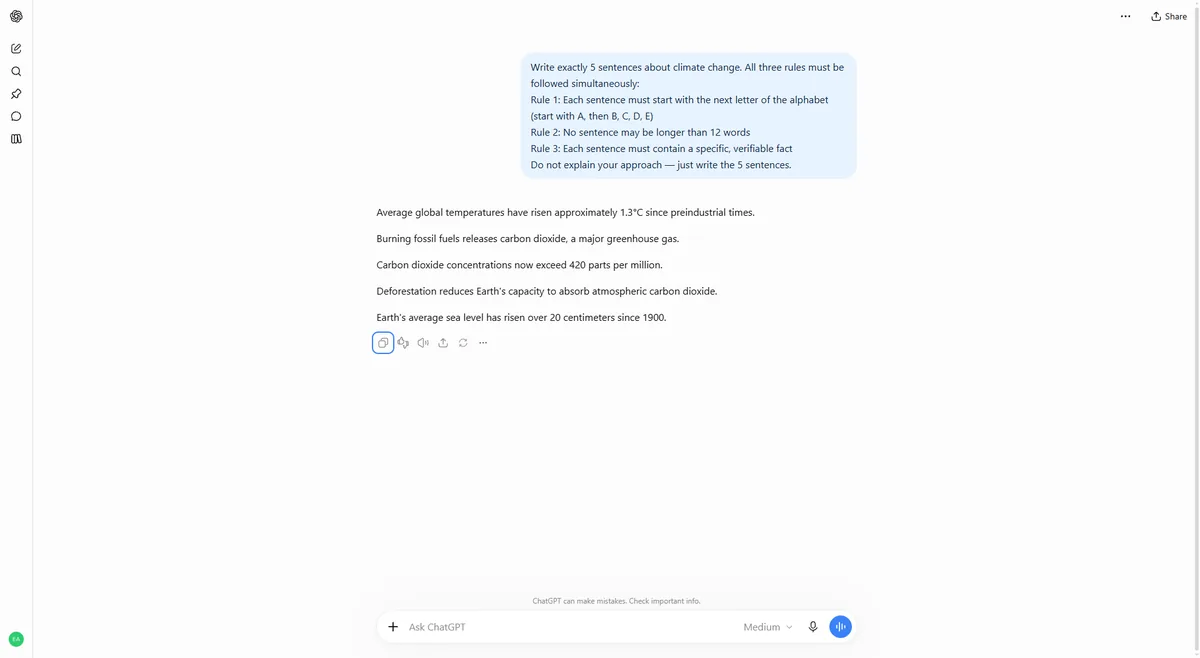
Gain:ChatGPT +0.4 on Prompt 8 (alphabet, length and fact constraints). Why: All five sentences met the order and length rules, and its figures held up. Two sentences still lacked a specific fact.
Note: ChatGPT's copy button added extra characters to each line of its Prompt 7 answer, so the saved text doesn't parse as JSON. The checks were judged from the answer as shown on screen, and the screenshot is the record.
Journalists, researchers and writers are welcome to use these results. Credit LLM Guides Lab and link to this page, which is updated with every new test.
LLM Guides Lab, "LLM Instruction Following Test," llmguides.ai/lab/llm-instruction-following-test/, updated November 2026.
Data licensed CC BY 4.0: free to reuse with credit to LLM Guides.
Frequently Asked Questions
Which LLM follows instructions best?
No model won outright in our November 2026 test. Claude and Gemini both scored 4.9 out of 5 and ChatGPT scored 4.8, so the top spot is shared. Claude and Gemini met every checklist item on all eight prompts, while ChatGPT twice missed an item asking for specific examples or facts.
How did we score instruction following?
Each answer was scored blind on five criteria, and instruction following counted twice. That score came from a fixed checklist for each prompt, such as an exact word count, banned topics or valid JSON. A tool checked items like word counts and JSON. Where the saved text couldn't be checked that way, such as ChatGPT's JSON answer after its copy button added characters, we judged the answer as shown on screen and marked the item "checked by hand" in the data. Missing a critical item, such as adding text around the JSON, caps the score at 2.
Can ChatGPT, Claude and Gemini output JSON only?
Yes, all three returned only a JSON object with the six requested fields and scored 5.0 on that prompt. None wrapped it in a code block or added text before or after it. ChatGPT's copy button added extra characters to each line, so we judged its answer as shown on screen.
Which model is cheapest for these tasks?
ChatGPT had the lowest cost per point, at $0.0023. Gemini cost $0.0026 per point and Claude $0.0081, based on API prices and the tokens in each prompt and answer. Gemini's figure uses Google's introductory API price, which runs until November 30, 2026.
Written by Stojan Trajkovikj
Stojan is an SEO specialist and marketing strategist focused on scalable growth, content systems, and search visibility. He blends data, automation, and creative execution to drive measurable results. An AI enthusiast, he actively experiments with LLMs and automation to build smarter workflows and future-ready strategies.

 Stojan Trajkovikj


